
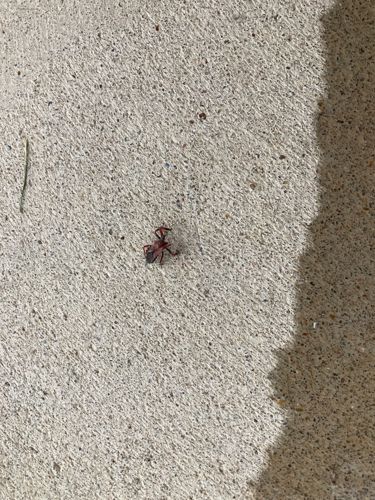
Velvet Ant (likely a species of Dasymutilla)
Dasymutilla sp. (specific species cannot be determined from the image alone)
- Order & Family
- Order: Hymenoptera, Family: Mutillidae
- Size
- Typically range from 0.5 to 2.5 cm (0.2 to 1 inch) in length, though some species can be larger.
Natural Habitat
Typically found in sandy areas, grasslands, open woodlands, and disturbed areas. They prefer dry, open habitats.
Diet & Feeding
Larvae are parasitic on the larvae and pupae of other ground-nesting bees and wasps. Adults primarily feed on nectar and water, although they may also consume honeydew.
Behavior Patterns
Velvet ants are solitary insects. The females are wingless and resemble ants, but they are actually wasps. Males are winged. Females are known for their extremely painful sting, hence the nickname "cow killer." They search for ground-nesting bees and wasps, paralyzing them and laying an egg on or near the host larva. The velvet ant larva then feeds on the host. They are active during the day, often seen scurrying across open ground.
Risks & Benefits
Risk: The primary risk is their extremely painful sting, particularly from the wingless females. While not typically medically dangerous, the pain can be intense and long-lasting. Benefits: As parasitoids, they help control populations of other ground-nesting insects, including some pest species, making them a natural form of pest control. They also contribute to pollination as adults feed on nectar.