
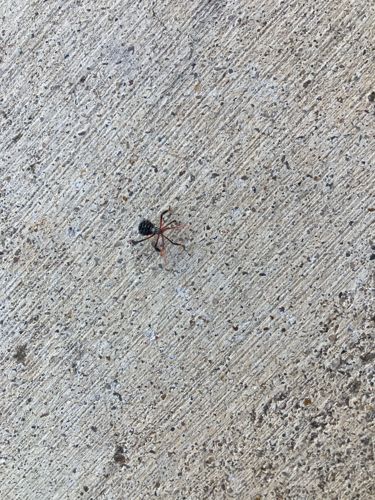
Velvet Ant (often referred to as 'Cow Killer')
Dasymutilla occidentalis (one of the more common species, but there are many species within Mutillidae)
- Order & Family
- Order: Hymenoptera, Family: Mutillidae
- Size
- Typically range from 0.5 to 2.5 cm (0.2 to 1 inch) in length. The one in the image appears to be on the smaller to medium side within this range.
Natural Habitat
They are typically found in sandy areas, open fields, grasslands, woodlands, and even urban environments like lawns and sidewalks. They prefer dry, open habitats where their host insects are common.
Diet & Feeding
Adult velvet ants feed on nectar from flowers. Larvae are external parasites of the pupae or larvae of other ground-nesting solitary bees and wasps, particularly those in the families Sphecidae and Halictidae.
Behavior Patterns
Velvet ants are solitary wasps. Females are wingless and resemble ants, while males have wings. Females are known for their painful sting, hence the common name 'cow killer'. They are active during the day, often seen running rapidly on the ground in search of host nests. Males can fly and are often seen near flowers.
Risks & Benefits
Risk: The primary risk associated with velvet ants is their extremely painful sting, particularly from the female. While generally not medically significant for humans beyond the intense pain, they should be avoided. They are not aggressive unless provoked. Benefit: As parasitic wasps, they help to control populations of other ground-nesting insects, some of which might be considered pests.