
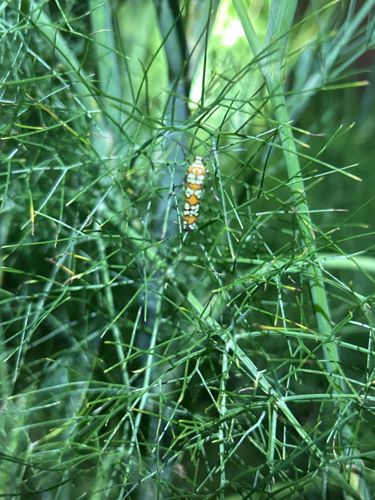
Ailanthus Webworm Moth (larva)
Atteva aurea
- Order & Family
- Order: Lepidoptera, Family: Attevidae (formerly Yponomeutidae)
- Size
- Larvae can grow up to 2.5 cm (1 inch) in length. Adult moths have a wingspan of approximately 2-3 cm (0.8-1.2 inches).
Natural Habitat
Found in areas where their host plants, particularly the Tree of Heaven (Ailanthus altissima), are abundant. This includes urban areas, disturbed sites, roadsides, fencerows, and woodland edges. They are common in North America and parts of Europe and Asia where their host plants are established.
Diet & Feeding
The larvae (caterpillars) feed on the leaves and sometimes the bark of their host plants, primarily Ailanthus altissima (Tree of Heaven). They are also known to feed on other plants in the Simaroubaceae family, such as Sumac species (Rhus spp.). The adults primarily feed on nectar from various flowers.
Behavior Patterns
Larvae are voracious eaters, often found actively feeding on their host plants. They can be found individually or in small groups. When disturbed, they may rear their head or thrash their body. As they grow, they molt through several instars. The adult moths are typically nocturnal and are attracted to lights. They are relatively strong flyers.
Risks & Benefits
Risks: The primary 'risk' associated with Ailanthus Webworm Moths is the defoliation of their host plant, the Tree of Heaven. While this can be a nuisance in ornamental plantings, the Tree of Heaven is often considered an invasive species, so the defoliation caused by these caterpillars can be seen as a form of biological control. However, they can also occasionally feed on native sumacs, which could be considered a minor risk to native plants. Benefits: As a defoliator of an invasive tree species, they contribute to the control of Ailanthus altissima. They are also part of the broader food web, serving as a food source for birds and other insectivores. Adult moths act as pollinators by feeding on nectar.