
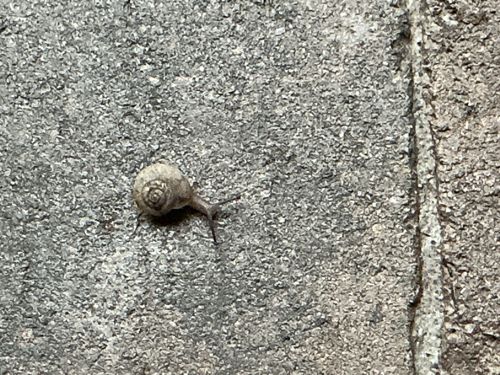
Snail
Class Gastropoda (general)
- Order & Family
- Stylommatophora (Order) / Various families, commonly Helicidae (Land snails)
- Size
- Typically from a few millimeters (e.g., less than 0.1 inch) to several centimeters (e.g., 2-3 inches or more) in shell diameter or body length, depending on the species.
Natural Habitat
Snails are highly adaptable and can be found in a wide range of habitats, both terrestrial and aquatic. Terrestrial snails prefer moist environments such as gardens, woodlands, grasslands, under rocks, logs, and leaf litter. Aquatic snails live in freshwater (ponds, lakes, streams) and marine environments (intertidal zones, deep sea).
Diet & Feeding
Snails are primarily herbivores, feeding on a wide variety of plant material including leaves, stems, flowers, and fruits. Some species may consume fungi, algae, and detritus (decaying organic matter), and a few carnivorous species exist but are less common.
Behavior Patterns
Snails are known for their slow movement, propelled by waves of muscular contractions on their underside. They are primarily nocturnal or active after rain to avoid dehydration. They retreat into their shells for protection from predators and adverse environmental conditions (e.g., dry weather, winter hibernation). They are hermaphroditic, meaning each individual has both male and female reproductive organs, and typically reproduce by exchanging sperm.
Risks & Benefits
Risks: Some snail species can be significant agricultural and garden pests, causing damage to crops and ornamental plants. They can also be vectors for parasites that can affect humans and livestock (e.g., liver flukes). Benefits: Snails play a role in decomposition and nutrient cycling by breaking down organic matter. They serve as a food source for various animals, including birds, reptiles, amphibians, and some mammals. Their shells contribute to calcium carbonate cycling.