
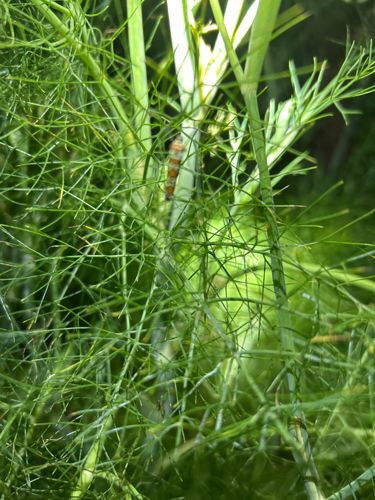
Eastern Black Swallowtail (young instar likely)
Papilio polyxenes
- Order & Family
- Order: Lepidoptera, Family: Papilionidae
- Size
- Caterpillars grow from a few millimeters (when newly hatched) to about 5-6 cm (2-2.5 inches) in their final instar. Adult butterflies have a wingspan of approximately 7-9 cm (2.8-3.5 inches).
Natural Habitat
Found in open, sunny areas such as gardens, fields, meadows, parks, and disturbed areas where their host plants grow. They are common across most of eastern North America.
Diet & Feeding
Herbivorous. Caterpillars feed on the foliage of host plants, which are typically members of the carrot family (Apiaceae), such as parsley, dill, fennel (as seen in the image), carrot, and Queen Anne's Lace. Adult butterflies primarily feed on nectar from a wide variety of flowering plants.
Behavior Patterns
The caterpillar seen here is likely in an early instar, as evidenced by its small size and color patterns. As they grow, Eastern Black Swallowtail caterpillars typically change their appearance, often becoming green with black bands and yellow spots in later instars. They are herbivorous and will spend most of their caterpillar stage feeding on host plants to grow before pupating into a chrysalis. When disturbed, they can evert an osmeterium, a Y-shaped orange or yellow scent gland located behind their head, which releases a foul-smelling substance to deter predators.
Risks & Benefits
Potential Risks: As caterpillars, they can cause some defoliation to culinary herbs like parsley and dill, which can be a minor nuisance to gardeners. Potential Benefits: As adults, Eastern Black Swallowtails are important pollinators, contributing to the reproduction of many plants. They are also a beautiful and charismatic species that adds to biodiversity.