
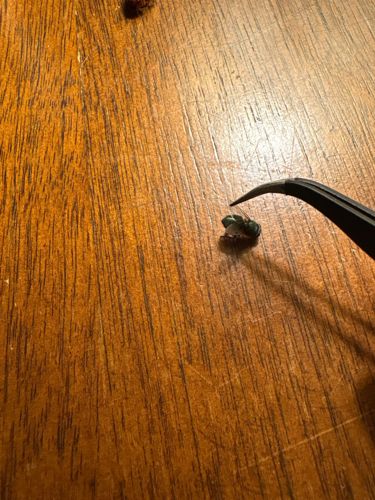
Blow Fly (likely a Green Bottle Fly)
Likely Calliphora spp. or Lucilia spp. (e.g., Lucilia sericata, scientific name for common green bottle fly)
- Order & Family
- Order: Diptera, Family: Calliphoridae
- Size
- (Adults) 4-16 mm (typically 6-12 mm)
Natural Habitat
Blow flies are common globally and can be found in diverse habitats, especially where decaying organic matter is present. This includes rural and urban environments, near garbage, compost piles, landfills, slaughterhouses, and in natural areas with decaying animal carcasses.
Diet & Feeding
Adult blow flies feed on a variety of sugary substances, including nectar, fruit juices, and decaying organic matter. Larvae (maggots) are scavengers and primarily feed on decaying animal flesh (carrion), feces, and sometimes decaying plant matter.
Behavior Patterns
Blow flies undergo complete metamorphosis: egg, larva (maggot), pupa, and adult. Females lay eggs on decaying organic matter, which hatch into maggots that feed and grow, then pupate. Adults are strong fliers and are attracted to carrion, feces, and other putrefying substances. They are often among the first insects to arrive at a carcass, making them useful in forensic entomology.
Risks & Benefits
Risks: Blow flies can be vectors for various pathogens, including bacteria (e.g., E. coli, Salmonella), leading to food contamination and disease transmission. Their presence can also indicate unsanitary conditions. Some species can cause myiasis in animals (and rarely humans), where larvae infest living tissue. Benefits: They play a crucial role as decomposers in ecosystems by breaking down organic matter. They are important in forensic entomology for estimating time of death due to their predictable arrival patterns on corpses. Some species are used in maggot therapy for wound debridement in medicine.