
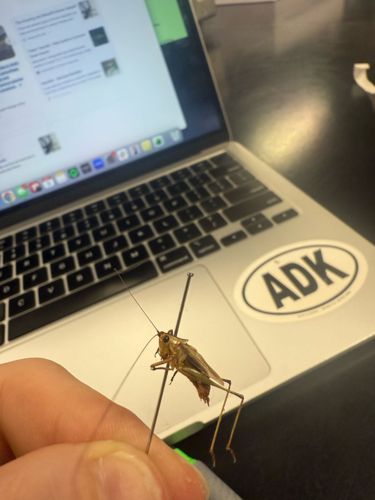
Cricket (likely a house cricket or field cricket)
Acheta domesticus (House Cricket) or Gryllus (Field Cricket species)
- Order & Family
- Orthoptera, Gryllidae
- Size
- Typically 0.5 to 1.5 inches (1.3 to 3.8 cm) in length, excluding antennae.
Natural Habitat
House crickets often live indoors in warm, dark places, such as basements, attics, and cluttered areas. Field crickets prefer outdoor environments like grasslands, fields, and gardens, often seeking shelter under rocks, logs, or in cracks in the ground.
Diet & Feeding
Crickets are omnivores. They feed on a variety of organic matter including plants, seeds, fruits, fungi, and sometimes other small insects or decaying animal matter. Indoors, they might consume fabric, paper, or food scraps.
Behavior Patterns
Crickets are primarily nocturnal. Male crickets are known for their characteristic chirping sound, produced by rubbing their forewings together (stridulation), primarily to attract females and ward off other males. They are good jumpers due to their strong hind legs. They undergo incomplete metamorphosis, meaning they hatch as nymphs that resemble smaller versions of adults.
Risks & Benefits
Potential risks include being a nuisance by their chirping, especially indoors, and occasional damage to fabrics or plants. They do not bite humans or transmit diseases. Benefits include serving as a food source for many animals (birds, reptiles, small mammals) and being used as live food for pets. They also contribute to decomposition by consuming organic matter.