
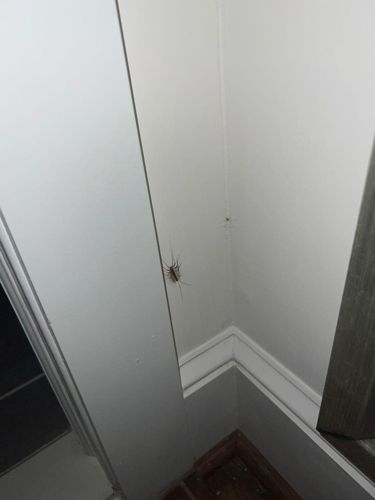
House Centipede
Scutigera coleoptrata
- Order & Family
- Order: Scutigeromorpha, Family: Scutigeridae
- Size
- Body length usually ranges from 1 inch (2.5 cm) to 1.5 inches (3.8 cm), but their numerous long legs can make them appear much larger, up to 3-4 inches (7.6-10 cm) including leg span.
Natural Habitat
House centipedes prefer damp, dark, and secluded environments. Indoors, they are commonly found in basements, bathrooms, crawl spaces, and closets, especially areas with high humidity. Outdoors, they can be found under rocks, logs, leaf litter, and in other moist ground cover.
Diet & Feeding
Strictly carnivorous; they feed on a variety of household pests, including insects and arachnids such as cockroaches, termites, silverfish, spiders, bed bugs, and other small arthropods. They use their front legs and venom to capture and paralyze their prey.
Behavior Patterns
House centipedes are nocturnal hunters, typically resting during the day and actively seeking prey at night. They are known for their incredibly fast movement, darting across surfaces when disturbed. They are solitary creatures and do not form colonies. Their speed and agility allow them to capture quick-moving prey like spiders and cockroaches. They often try to escape when encountered.
Risks & Benefits
While generally harmless to humans, house centipedes can bite if provoked or handled, resulting in a mild sting similar to a bee sting, though this is rare as their jaws are typically too weak to penetrate human skin effectively. Some individuals might experience localized redness, swelling, or pain. They are largely beneficial as natural pest control, preying on many common household insect pests.