
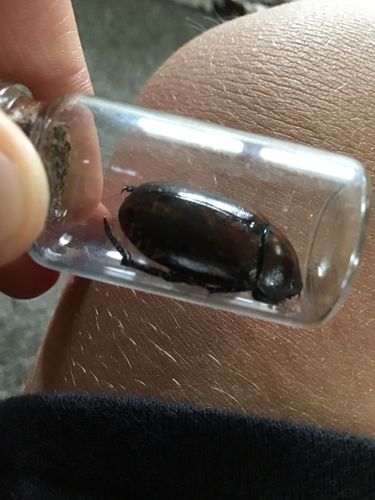
Darkling Beetle
Tenebrionidae (A Family of Beetles)
- Order & Family
- Order: Coleoptera, Family: Tenebrionidae
- Size
- Species in the Tenebrionidae family vary greatly in size, ranging from less than 5 mm to over 30 mm in length. The specimen in the image appears to be in the moderate size range for the family, likely between 10-20 mm.
Natural Habitat
Darkling beetles are found in a wide variety of habitats globally, particularly in arid and semi-arid regions. They commonly inhabit deserts, grasslands, forests, and agricultural fields. They can be found under rocks, logs, bark, in soil, and within stored grain products.
Diet & Feeding
The diet of Darkling Beetles varies widely by species. Many are scavengers, feeding on decaying plant and animal matter, fungi, and detritus. Some are herbivorous, consuming seeds, grains, roots, or decaying wood. Certain species can be significant pests of stored products, feeding on flour, cereals, and other dried goods.
Behavior Patterns
Many species of Tenebrionidae are nocturnal, hiding during the day under logs, rocks, or in crevices. They are generally slow-moving. Many species employ chemical defenses, secreting noxious compounds from glands in their abdomen when disturbed. The larvae (often called mealworms or false wireworms) live in soil or decaying wood and can be quite destructive to crops. Adults are long-lived compared to many other insects.
Risks & Benefits
Risks: Some species, particularly the larvae (e.g., mealworms, false wireworms), can be significant agricultural pests, damaging crops, stored grains, and root systems. They can also be a nuisance when found in large numbers in homes or food storage areas. Benefits: Many species are important detritivores, aiding in the decomposition of organic matter and nutrient cycling in ecosystems. Some species are used as feeder insects for pets (e.g., mealworms for reptiles, birds).