
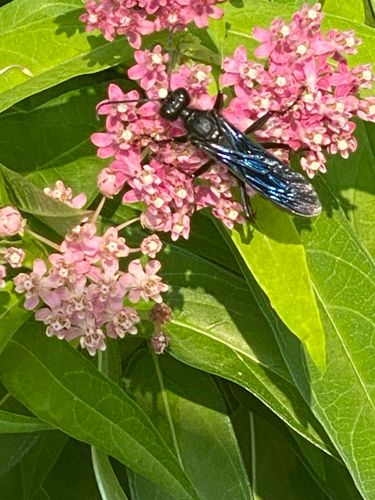
Great Black Wasp
Sphex pensylvanicus
- Order & Family
- Order: Hymenoptera, Family: Sphecidae
- Size
- Typically 2.0 - 2.5 cm (0.8 - 1.0 inches) in length
Natural Habitat
Commonly found in open, sunny areas such as meadows, gardens, fields, and along forest edges where suitable flowers and prey are abundant. They often nest in sandy or loose soil.
Diet & Feeding
Adults feed on nectar from various flowers, particularly those with shallow corollas, for energy. Larvae are carnivorous, feeding on paralyzed katydids and crickets provided by the mother wasp.
Behavior Patterns
Adults are active during the day, often seen flying swiftly near the ground or foraging on flowers. Females provision their nests with paralyzed prey (often katydids or crickets) for their larvae to feed on. Males are territorial and may patrol areas looking for females.
Risks & Benefits
Potential risks include a sting if greatly provoked, though they are generally not aggressive towards humans. Benefits include pollination of a variety of plants as they forage for nectar, and natural pest control as the larvae consume herbivorous insects like katydids and crickets.