
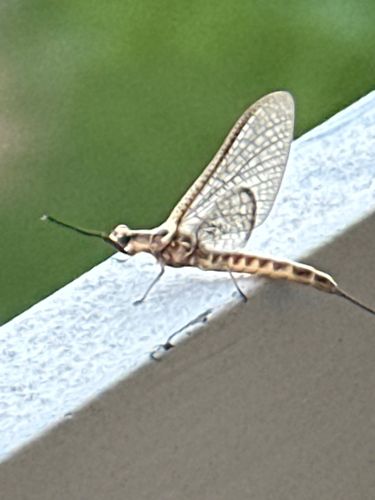
Mayfly
There are over 3,000 species of mayflies worldwide. A specific scientific name cannot be given without detailed morphological examination. Examples include: Hexagenia limbata (Giant Mayfly), Ephemera danica (Green Drake).
- Order & Family
- Order: Ephemeroptera (This order contains many families, each with specific scientific names. Without more detailed features, pinpointing a single family is difficult for a general Mayfly image.)
- Size
- Mayflies vary in size depending on the species and stage. Nymphs can range from a few millimeters to over 3 cm (1.2 inches). Adult body lengths typically range from 2 mm to 3 cm (0.08 to 1.2 inches), with wingspans up to 5 cm (2 inches) for larger species. The species in the image appears to be on the larger side of this range.
Natural Habitat
Mayflies are aquatic insects during their nymphal stage. Nymphs are found in various freshwater environments, including streams, rivers, lakes, and ponds. Different species have adaptations for living in fast-flowing water, still water, or burrowing in sediment. Adult mayflies are typically found near the aquatic habitats where they emerged, often resting on vegetation or structures close to the water.
Diet & Feeding
Adult mayflies do not feed. Mayfly nymphs are primarily detritivores, feeding on decaying organic matter, and herbivores, grazing on algae and diatoms. Some species are filter feeders, while a few are predatory on other small aquatic invertebrates.
Behavior Patterns
Mayflies are hemimetabolous insects, undergoing incomplete metamorphosis. Their life cycle consists of three main stages: egg, nymph, and adult. The nymphal stage is aquatic and can last from several months to a year or more. Nymphs typically feed on algae and detritus. When the nymph is ready to become an adult, it molts into a subimago (dun), which is a winged, sexually immature stage unique to mayflies. The subimago flies to a sheltered location (often vegetation near water) and molts one final time into the sexually mature imago (spinner) within a day or two. Adults live only for a few hours to a few days, solely for reproduction. They do not feed as adults. Mating swarms, often occurring at dusk, are a characteristic behavior, with males performing aerial displays to attract females. Females lay their eggs on or in the water. Mayflies are highly sensitive to water quality, making them important bioindicators.
Risks & Benefits
Risks: Mayflies are generally harmless to humans. They do not bite or sting. However, in extremely large emergence events (known as hatches or swarms), their sheer numbers can be a nuisance, coating surfaces, reducing visibility on roads, and posing slip hazards. Benefits: Mayflies are excellent bioindicators of water quality; their presence and diversity indicate a healthy aquatic ecosystem. They are a crucial food source for many aquatic and terrestrial predators, including fish (especially trout), birds, bats, and other insects. This makes them incredibly important in aquatic food webs. Anglers often imitate mayflies with artificial flies due to their importance in fish diets.