
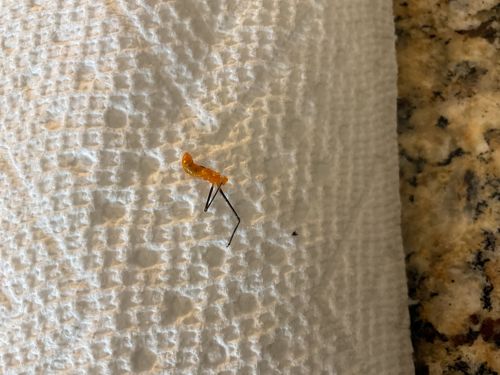
Non-biting Midge (likely a male with visible plume-like antennae fragments)
Chironomidae (family encompassing many genera and species)
- Order & Family
- Order: Diptera, Family: Chironomidae
- Size
- Larvae can range from a few millimeters up to 30 mm (1.2 inches), depending on the species. Adult non-biting midges typically range from 1 to 10 mm (0.04 to 0.4 inches) in length, with some larger species reaching up to 12 mm.
Natural Habitat
Larvae are primarily aquatic, found in a wide variety of freshwater environments including ponds, lakes, streams, and even temporary puddles. Some species can also be found in brackish or saltwater. Adults are terrestrial but remain close to their larval breeding grounds, often found near bodies of water.
Diet & Feeding
Larvae of non-biting midges feed on organic detritus, algae, diatoms, and small aquatic organisms found in the water. Adult non-biting midges typically do not feed; they live off energy reserves accumulated during their larval stage.
Behavior Patterns
Larvae develop in water, pupating shortly before emerging as adults. Adult midges are often found swarming, especially around dusk or dawn near water bodies. Males form mating swarms to attract females. Their lifespan as adults is very short, often only a few days, during which their primary purpose is reproduction. They do not feed as adults.
Risks & Benefits
Non-biting midges pose no direct risk to humans as they do not bite or transmit diseases. They can, however, be a nuisance in large numbers, particularly near homes or outdoor recreational areas (e.g., swarming). Environmentally, they are a crucial part of aquatic food webs, serving as a significant food source for fish, aquatic insects, and birds both in their larval and adult stages. They also play a role in nutrient cycling as decomposers in aquatic ecosystems.