
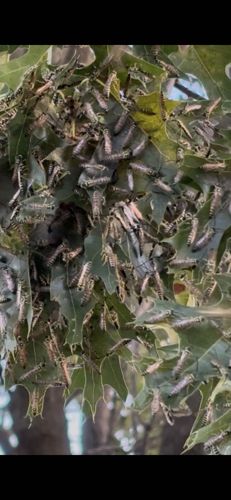
Gypsy Moth (caterpillar stage)
Lymantria dispar dispar (European Gypsy Moth) or Lymantria dispar (used more broadly, especially as the genus includes different subspecies/species)
- Order & Family
- Order: Lepidoptera, Family: Erebidae (formerly Lymantriidae)
- Size
- Caterpillars (larvae) typically range from 0.5 to 7 cm (0.2 to 2.8 inches) in length, growing larger through successive instars. Adult moths have a wingspan of about 3.5 to 6.5 cm (1.4 to 2.6 inches), with males being smaller than females.
Natural Habitat
Gypsy moths originated from Eurasia and North Africa and were introduced to North America. They thrive in forested areas, woodlands, urban and suburban landscapes with abundant host trees. Their egg masses can be found on tree trunks, branches, outdoor furniture, vehicles, and other surfaces, aiding in their spread. The caterpillars are found on the leaves and branches of their host plants.
Diet & Feeding
The primary diet of gypsy moth caterpillars consists of the leaves of a wide variety of deciduous and coniferous trees and shrubs. They are generalist feeders but have a preference for oak, aspen, birch, apple, and willow. During large outbreaks, they can defoliate entire forests, leading to stress on the trees, making them more susceptible to other pests and diseases, and potentially leading to tree mortality.
Behavior Patterns
Gypsy moth caterpillars (larvae) are known for their voracious appetite. They are most active feeders during the larval stage, undergoing several instars (growth stages) before pupating. During outbreaks, their sheer numbers can cause significant defoliation. The caterpillars spin silk threads, which they use to drop from trees, especially when disturbed or seeking new feeding sites; these threads can also be used for dispersal by wind (ballooning) when they are young. Adult moths are typically short-lived and do not feed; their primary purpose is reproduction. Males are strong fliers, while females are flightless or poor fliers, often laying their egg masses on tree trunks, branches, or other surfaces.
Risks & Benefits
Risks: Gypsy moth outbreaks pose significant ecological and economic risks. They cause widespread defoliation of forests, leading to tree stress, reduced tree growth, increased susceptibility to other pests/diseases, and tree mortality. This impacts timber production, wildlife habitat, and aesthetic values of landscapes. Their presence can also be a nuisance to humans, as their droppings (frass) rain down from trees, and the caterpillars' hairs can cause allergic reactions, skin rashes, or respiratory issues in some individuals. Benefits: In their native range, they are part of a balanced ecosystem. In invaded ranges, there are few direct benefits, though their defoliation can sometimes indirectly benefit specific understory plants that thrive with increased light. They do serve as a food source for some predators and parasitoids, but rarely enough to control major outbreaks.