
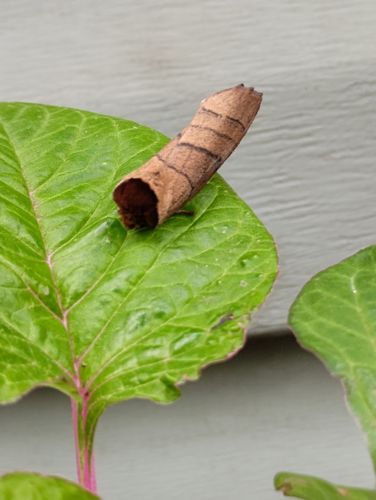
Bagworm Moth (Casebearer)
Psychidae (a family, not a single species, as the exact species cannot be determined from the image alone)
- Order & Family
- Order: Lepidoptera, Family: Psychidae
- Size
- Larval cases vary greatly by species and age, typically ranging from 0.5 inches (1.2 cm) to 2.5 inches (6.4 cm) or more in length. The actual larvae inside are commensurate with the case size. Adult moths are generally small to medium-sized, with wingspans of 0.4 to 1.6 inches (1 to 4 cm), though some species can be larger.
Natural Habitat
Bagworm moths are found in areas with suitable host plants, including forests, woodlands, urban landscapes, orchards, and nurseries. The larvae are found on the leaves or twigs of their host plants, often camouflaged by their cases.
Diet & Feeding
Larvae (caterpillars) of bagworm moths are herbivorous and typically feed on the foliage of a wide variety of plants, including conifers (e.g., cedar, juniper, pine, spruce) and deciduous trees/shrubs (e.g., arborvitae, willow, maple, apple). Different species may have preferred host plants. Adult moths usually do not feed.
Behavior Patterns
The larva builds a portable case from silk and various plant materials, which it carries everywhere for protection. As it grows, the larva adds to and enlarges its case. They are generally slow-moving. When disturbed, they retreat entirely into their case. Adult moths are typically nocturnal and short-lived, with their primary purpose being reproduction.
Risks & Benefits
Risks: Bagworm larvae can be significant pests of ornamental trees and shrubs, particularly conifers. Heavy infestations can lead to defoliation, stunted growth, and even the death of host plants. Benefits: Bagworms are part of the ecosystem food chain, serving as a food source for birds and parasitic insects. However, their benefits are generally outweighed by their potential for damage in horticultural settings.