
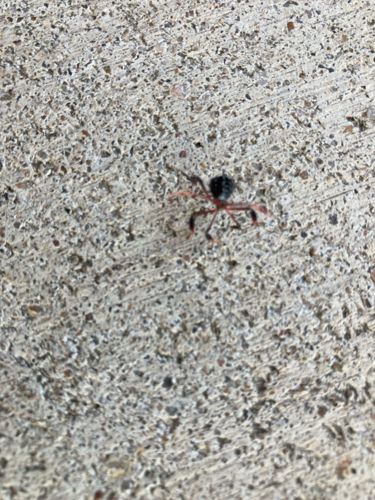
Velvet Ant (likely a species of Dasymutilla)
Dasymutilla spp. (e.g., Dasymutilla occidentalis, Dasymutilla klugii)
- Order & Family
- Order: Hymenoptera, Family: Mutillidae
- Size
- Typically ranges from 0.5 cm to 2.5 cm (0.2 to 1 inch) in length, depending on the species.
Natural Habitat
Velvet ants are found in various habitats, often in sandy or open areas, grasslands, fields, and even suburban environments where their host insects are present. They are commonly seen walking on the ground.
Diet & Feeding
Adult velvet ants feed on nectar, water, and sometimes other insect fluids. The larvae are external parasites (ectoparasitoids) of the larvae and pupae of ground-nesting bees and wasps, and occasionally beetles.
Behavior Patterns
Velvet ants are solitary wasps, not true ants, despite their common name. Females are wingless and typically found scurrying across open ground in search of host nests. They are known for their extremely painful sting, often referred to as the 'cow killer' due to its intensity, though it is not lethal to cows or humans. Males are winged and can fly, but they do not sting. Mating usually occurs when a winged male finds a wingless female.
Risks & Benefits
The primary risk associated with velvet ants is their extremely painful sting, particularly from the females. While the sting is not medically significant for most people (i.e., not venomous to the point of causing severe systemic reactions in healthy individuals, barring allergic reactions), it is one of the most painful insect stings. Benefits include their role as natural population regulators of ground-nesting bees and wasps, which can be seen as a form of biological control.