
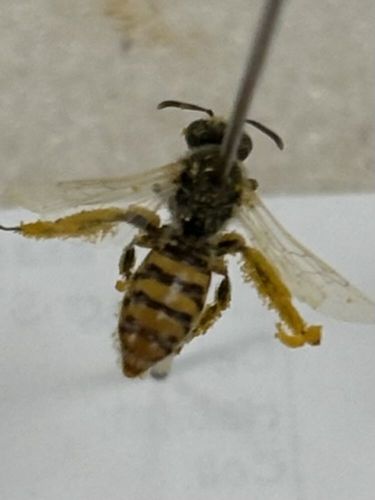
Sweat Bee or Halictid Bee
Family Halictidae (specific genus/species not discernible from image)
- Order & Family
- Order Hymenoptera, Family Halictidae
- Size
- 3-10 mm, with some larger species up to 15 mm. The bee in the image appears to be on the smaller to medium side of this range.
Natural Habitat
Widely distributed in various habitats worldwide, including forests, grasslands, gardens, urban areas, and agricultural fields. They often nest in the ground, in burrows they excavate, or sometimes in wood.
Diet & Feeding
Adult sweat bees feed on nectar for energy. Larvae are provisioned with a mixture of pollen and nectar by the female bee.
Behavior Patterns
Many sweat bees are solitary, with each female building and provisioning her own nest. However, a significant number of species exhibit some level of social behavior, ranging from communal nesting (multiple females share a nest entrance but provision their own cells) to primitively eusocial colonies with a queen and sterile workers. They are active during the day, foraging for pollen and nectar from various flowers. The yellow fuzzy legs in the image clearly show pollen collection structures (scopae).
Risks & Benefits
Benefits: Sweat bees are important pollinators of a wide range of plants, including many agricultural crops and wildflowers. Their pollination services are crucial for ecosystem health and food production. Risks: As their common name suggests, some species are attracted to human sweat and may sting if provoked or trapped against the skin. While their sting is generally mild, it can be a nuisance. They are not typically aggressive unless directly threatened.