
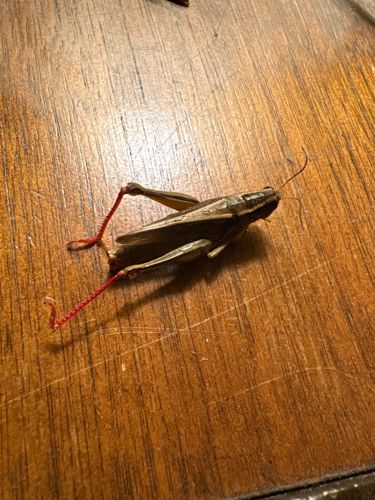
Grasshopper (likely Short-horned Grasshopper)
Too difficult to determine the exact species from the image alone, but it falls under the suborder Caelifera.
- Order & Family
- Order: Orthoptera, Family: Acrididae (Short-horned Grasshoppers). The specific red structures on the legs are unusual and might be a string or foreign object attached to the grasshopper.
- Size
- Typically 1 to 7 cm (0.4 to 2.8 inches) in length, depending on the species. Larger species can exceed this range.
Natural Habitat
Grasshoppers are found in a wide range of terrestrial habitats, including grasslands, meadows, fields, gardens, farmlands, and open woodlands. They prefer areas with abundant vegetation for feeding and camouflage.
Diet & Feeding
Herbivorous. Grasshoppers primarily feed on a wide variety of plants, including grasses, leaves, and crops. Their diet can vary depending on the species and the availability of vegetation in their habitat.
Behavior Patterns
Orthoptera are well-known for their jumping ability, facilitated by their powerful hind legs. Many species, especially males, produce sounds (stridulation) by rubbing their legs against their wings or other body parts to attract mates. They undergo incomplete metamorphosis, meaning they hatch from eggs as nymphs that resemble miniature adults, molting several times before reaching maturity. They are generally solitary but can form swarms under certain conditions (especially locusts).
Risks & Benefits
Risks: Some species, particularly locusts (which are certain species of grasshoppers that exhibit swarming behavior), can be significant agricultural pests, causing widespread damage to crops and leading to food shortages. Benefits: Grasshoppers serve as an important food source for many animals, including birds, reptiles, amphibians, and other insects, playing a crucial role in the food web. They also contribute to decomposition and nutrient cycling in ecosystems by consuming plant matter.