
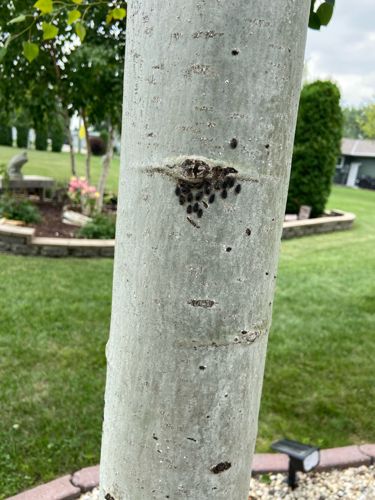
Sawfly Larvae (specifically, likely a species that feeds on trees like poplar or aspen)
Tenthredinidae (a family, specific genus/species would require closer examination of the larvae and host plant)
- Order & Family
- Order Hymenoptera, Family Tenthredinidae (or other Chalastrogastra families within Hymenoptera)
- Size
- Larvae typically range from 10 mm to 30 mm (0.4 to 1.2 inches) in length when fully grown, though the size can vary by species and instar. The individuals in the image appear to be small, likely early instar larvae.
Natural Habitat
Found in forests, woodlands, gardens, and urban areas wherever their host plants grow. The specific host plant varies greatly by sawfly species.
Diet & Feeding
Herbivorous. Larvae (caterpillars) feed on the leaves of a wide variety of plants, depending on the specific sawfly species. Given the host tree appears to be a poplar or aspen, these larvae would likely be defoliators of these trees.
Behavior Patterns
Larvae (caterpillars) typically hatch in late spring/early summer and begin feeding on the leaves. As they grow, they may molt several times. The aggregation seen in the image is probably a larval stage. Many species of sawflies, especially in their early instars, exhibit gregarious behavior, clustering together for protection or to feed more efficiently. Some sawflies overwinter as cocoons in the soil or under bark, while others overwinter as eggs.
Risks & Benefits
Risks: High populations can cause significant defoliation of host trees and shrubs, leading to reduced growth, stress, and in severe cases, tree mortality, especially for young or already weakened trees. They are considered pests when outbreaks occur in forestry or horticulture. Benefits: As part of the insect food web, they can be a food source for birds, parasitic wasps, and predatory insects. Some species play a minor role in nutrient cycling by breaking down plant material.