
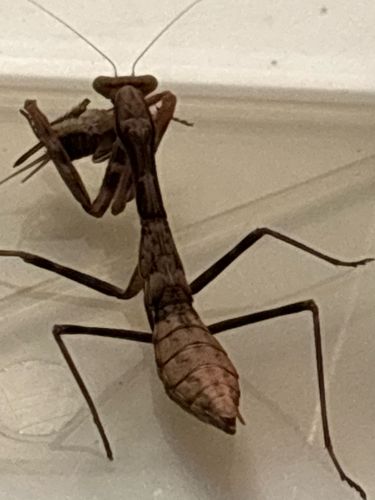
Praying Mantis
Mantodea (Order)
- Order & Family
- Order: Mantodea, Family: Mantidae (or various families within Mantodea, depending on classification)
- Size
- Most species range from 2 to 12 cm (0.8 to 4.7 inches) in length, though some tropical species can be larger.
Natural Habitat
Praying mantises are found in temperate and tropical regions worldwide. They typically inhabit areas with dense vegetation, such as gardens, meadows, forests, grasslands, and shrublands, where they can effectively camouflage themselves among leaves and stems.
Diet & Feeding
Carnivorous. Their diet primarily consists of other insects such as flies, crickets, moths, butterflies, grasshoppers, and beetles. Larger mantis species can, on rare occasions, prey on small vertebrates like lizards, frogs, small birds, or rodents, though this is not typical for most species.
Behavior Patterns
Praying mantises are predatory insects known for their distinctive 'praying' posture, which is actually their forelegs held in a position ready to strike prey. They are ambush predators, often remaining motionless and camouflaged, waiting for an unsuspecting insect to come within striking distance. They have excellent vision and can quickly rotate their triangular heads nearly 180 degrees to spot prey. Mating rituals can be complex, and sexual cannibalism (female eating the male during or after mating) is not uncommon in some species.
Risks & Benefits
Praying mantises pose no known risks to humans; they are not venomous and do not typically bite unless provoked. They are highly beneficial insects in gardens and agricultural settings due to their predatory nature, helping to control populations of various pest insects. This makes them valuable allies for natural pest control, reducing the need for chemical pesticides.