
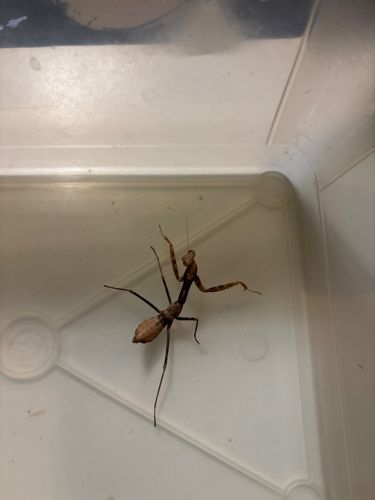
Praying Mantis (specifically, an Eremaphila mantis, often referred to as a "Stick Mantis" or "Desert Mantis" given its slender appearance and coloration suggesting desert camouflage)
Eremaphila sp. (species cannot be determined from the image alone)
- Order & Family
- Order: Mantodea, Family: Eremiaphilidae (or sometimes placed within Mantidae, depending on classification, but Eremiaphilidae is more specific for this genus)
- Size
- Generally, species within the Eremaphila genus can range from 2 to 7 cm (0.8 to 2.8 inches) in length, with females often being larger than males.
Natural Habitat
This type of mantis, with its slender body and coloration, is typically found in arid and semi-arid environments, including deserts, steppes, and dry shrublands. They often hide among dry vegetation, twigs, or on sandy substrates, where their camouflage is most effective.
Diet & Feeding
Strictly carnivorous. They feed on a wide variety of insects, including flies, moths, butterflies, crickets, grasshoppers, and sometimes even smaller mantises, small lizards, or frogs if the opportunity arises. Their diet largely depends on their size and what prey is available in their habitat.
Behavior Patterns
Mantises are predatory insects known for their distinctive "praying" posture. They are ambush predators, often remaining motionless for long periods, blending into their surroundings, and waiting for prey to come within striking distance. Their triangular head can turn almost 360 degrees, allowing them a wide field of vision. Mating can sometimes involve sexual cannibalism, where the female consumes the male during or after copulation.
Risks & Benefits
Praying mantises pose no risk to humans; they are not venomous and generally do not bite unless severely provoked. Benefits include their role as natural pest control agents, as they consume a large number of other insects that can be agricultural pests. They are an important part of the food chain in their ecosystems.