
African Mantis Identification Guide
A slender, adaptable praying mantis common across Africa, identified by its elongated body and a small dark spot inside the front legs.
Read the full African Mantis encyclopedia entry →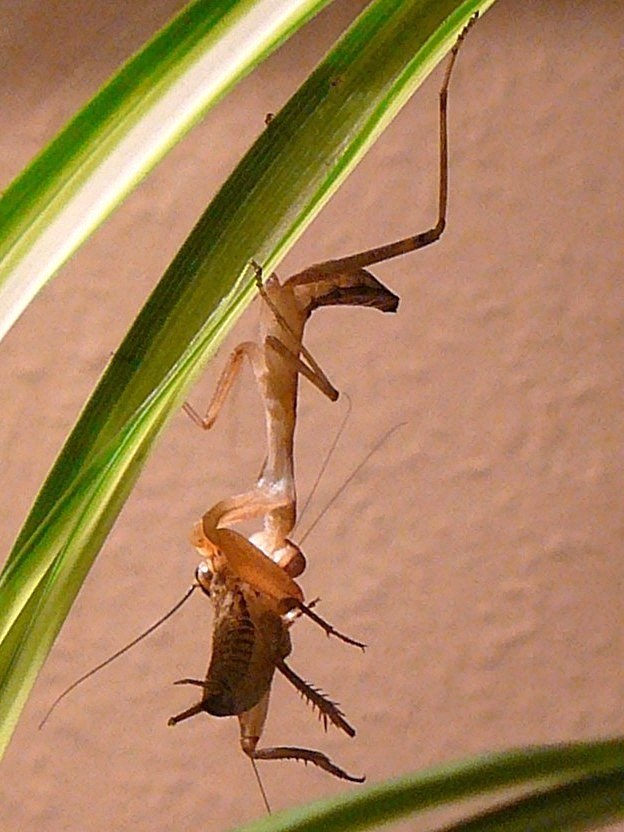
Key Visual Features
The African mantis (Sphodromantis species, often Sphodromantis lineola or related) is a widespread, classic-looking mantis common throughout much of Africa.
- Size: Medium to large, adults typically 2-3 inches (5-7.5 cm) long
- Color: Usually green, though tan or brownish color forms also occur, sometimes with a pale stripe running along the body
- Body shape: Elongated and slender, with the typical streamlined mantis silhouette — narrow thorax, long abdomen
- Wings: Full wings in adults extending to or near the tip of the abdomen, often green with a slightly translucent quality
- Legs: Raptorial front legs held folded; a key identifying feature is a small dark spot, sometimes with a light center, located on the inner surface near the base ("armpit") of each front leg, visible when the legs are extended
- Head: Triangular head with large, prominent compound eyes capable of swiveling to track movement
Where and When You'd See It
African mantises are found widely across sub-Saharan Africa in gardens, grasslands, shrubland, and agricultural areas, and the species has also become established elsewhere as an introduced species in some regions. They favor warm climates and are active during the warmer, wetter months, perching on leaves, stems, and shrubs in ambush posture during the day. Egg cases (oothecae) are attached to twigs or stems, with nymphs emerging in the warmer season.
Similar-Looking Bugs
- European mantis: Similar body shape and a comparable spot marking on the inner front leg, but the European mantis is generally native to different regions and can show a slightly different overall coloring and proportions
- Giant Asian mantis: Bulkier and broader-bodied than the more slender African mantis, with a bullseye spot positioned on the leg coxa rather than the "armpit" area
- Chinese mantis: Larger overall with a more elongated body and a different native range, generally lacking the same distinct spot pattern
- Other Sphodromantis relatives: Very similar in appearance; range and subtle proportions help narrow down the exact species
Quick ID Checklist
- Slender, elongated green (or tan) body
- Small dark spot with a pale center inside the base of the front legs
- Full wings reaching near the abdomen tip in adults
- Triangular head with large mobile compound eyes
- Found on garden plants, shrubs, and grasses across African habitats in warm seasons
Frequently asked questions
How can I confirm a mantis is an African mantis?
Check the inner base of the front legs for a small dark spot with a pale center, combined with a slender, elongated green body typical of the species.
What colors does the African mantis come in?
Most individuals are green, though tan or brownish color forms occur as well, sometimes with a pale stripe along the body.
How does it compare to the giant Asian mantis?
The African mantis is more slender overall, while the giant Asian mantis is bulkier and broader-bodied with its identifying spot located on a different part of the leg.
Where in Africa is this mantis typically found?
It is widespread across sub-Saharan Africa in gardens, grasslands, shrubland, and agricultural areas, and has also become established in some other regions.