
American House Spider Identification Guide
Identify this common indoor spider by its bulbous, mottled abdomen and irregular tangle-shaped web.
Read the full American House Spider encyclopedia entry →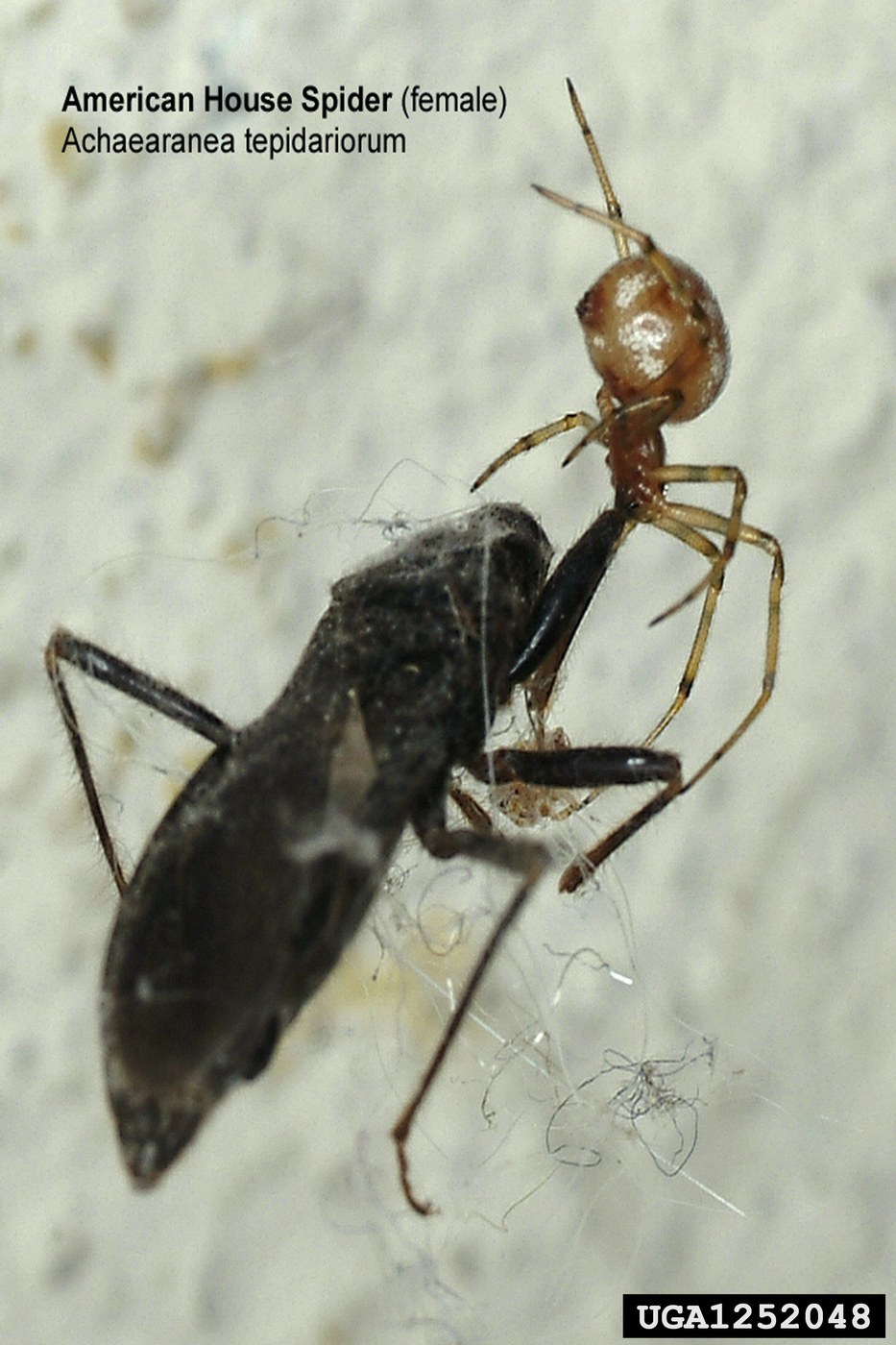
Key Visual Features
The American house spider (Parasteatoda tepidariorum) is one of the most commonly encountered indoor spiders, recognizable by its rounded body and messy web.
- Size: Females measure roughly 5-8 mm in body length, while males are smaller and more slender, typically around 3-6 mm.
- Abdomen shape: Large, bulbous, and rounded, often appearing almost spherical, especially in mature females — much larger in proportion than the head region (cephalothorax).
- Color & pattern: Base color ranges from dirty white to tan, gray, or brown, overlaid with darker mottled markings, chevrons, or blotchy patterns on top of the abdomen; coloring can vary noticeably between individuals.
- Legs: Long and thin relative to the body, banded with alternating lighter and darker segments, and used to move in a somewhat jerky, deliberate fashion across the web.
- Cephalothorax: Noticeably smaller and more uniformly colored than the abdomen, tan to brownish in tone.
- Eyes: Eight small eyes arranged in two rows, though not easily seen without close inspection.
Where and When You'd See It
This spider is common indoors year-round, favoring quiet, undisturbed corners such as ceiling corners, window frames, basements, garages, and closets. It also occurs outdoors in sheltered spots like under eaves, in sheds, or among rock piles. Its irregular, three-dimensional tangle web (a "cobweb") is a strong identifying clue on its own, often accumulating debris and prey remains over time. Activity can be observed at any time of day, though the spider often remains near the center or a retreat area of its web, becoming more active at night.
Similar-Looking Bugs
- Other cobweb spiders (Theridiidae family): Share a similar rounded abdomen and tangle-web habit, so overall body shape alone isn't always conclusive; pattern and color mottling help narrow it down.
- Widow spiders: Have a much more uniformly glossy, rounded abdomen (often solid black in mature females) rather than the mottled, patterned coloring typical of the American house spider.
- Cellar spiders: Have a much smaller, more elongated body and extremely long, thin legs, quite different from the compact, rounded shape of the house spider.
Quick ID Checklist
- Rounded, bulbous abdomen much larger than the head region
- Mottled tan, gray, or brown coloring with blotchy or chevron-like markings
- Long, thin, banded legs
- Builds a messy, irregular tangle (cobweb) rather than a symmetrical orb web
- Found in quiet indoor corners, basements, garages, or sheltered outdoor spots
Frequently asked questions
What is the easiest feature to spot on an American house spider?
Its large, rounded, mottled abdomen is the most noticeable feature, especially compared to its much smaller head region, giving the spider a distinctly bulbous, uneven silhouette.
How is the American house spider's web different from other spider webs?
It builds an irregular, three-dimensional tangle web, often called a cobweb, rather than the neat, symmetrical spiral pattern of an orb-weaver's web.
How can I tell an American house spider from a widow spider?
The American house spider has a mottled, patterned abdomen in tan, gray, or brown tones, while mature widow spiders typically show a much more uniform, glossy dark abdomen.
Where in a house is this spider usually found?
Look in quiet, undisturbed corners such as ceiling angles, window frames, basements, and closets, where its tangled web can remain intact for an extended time.