Anopheles Mosquito Identification Guide
Anopheles mosquitoes give themselves away by resting at a steep, head-down angle with their body tilted sharply away from the surface.
Read the full Anopheles Mosquito encyclopedia entry →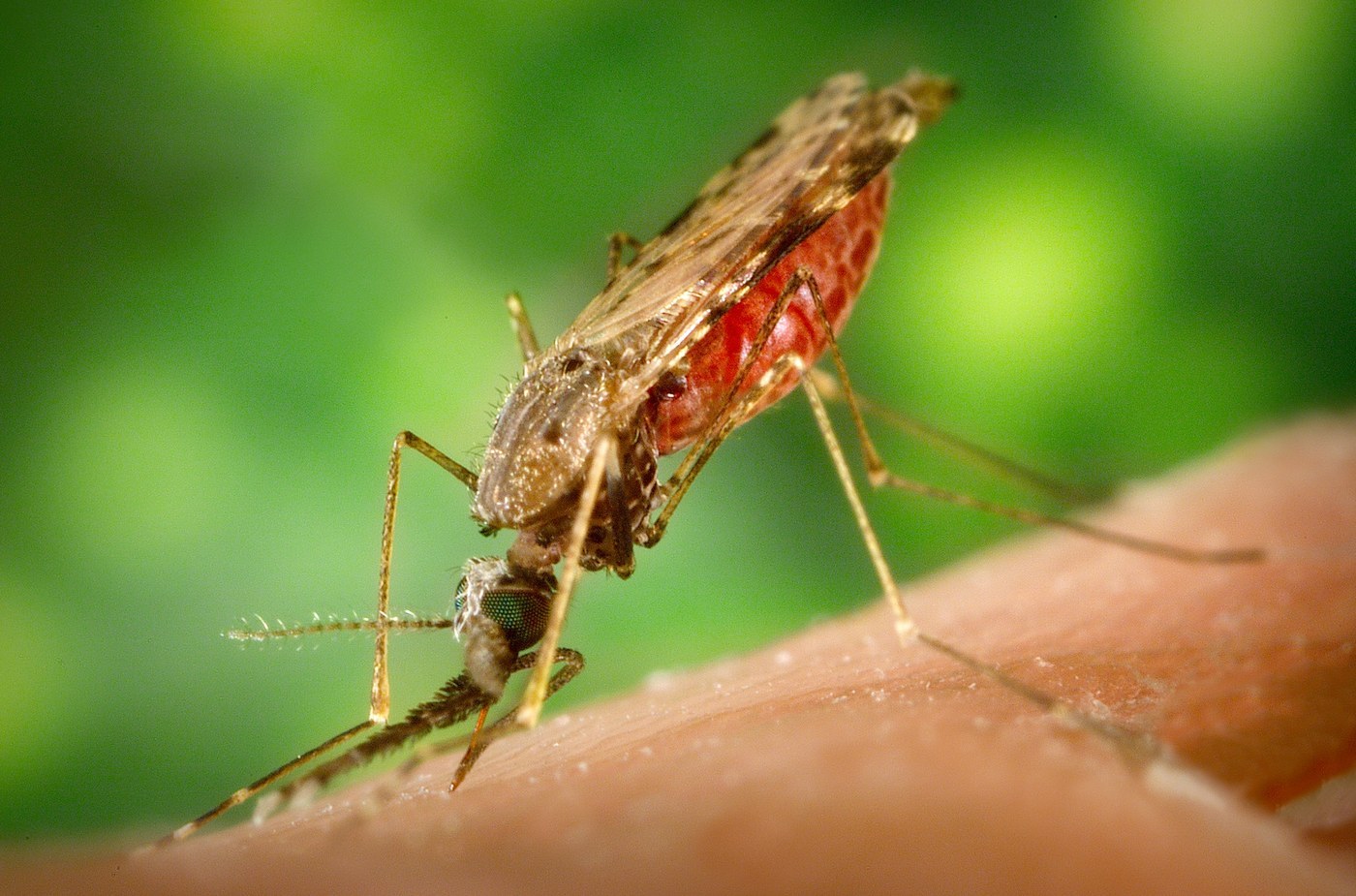
Key Visual Features
Anopheles mosquitoes are a genus recognizable largely through their distinctive resting posture and wing patterning.
- Size: Medium, roughly 5-8 mm long.
- Body color: Brown to dark brown, often with subtle mottling on the body.
- Wings: Frequently show scattered dark and pale scale patches, giving a mottled or spotted appearance rather than a uniform look.
- Resting posture: The clearest field mark — the body tilts upward at a steep angle, with the head down and the abdomen pointing up and away from the surface, unlike most other mosquitoes that rest nearly flat.
- Palps: Long palps near the proboscis, nearly as long as the proboscis itself in adults, visible as paired projections near the mouthparts.
- Legs: Long, slender legs, sometimes with faint pale banding depending on species.
Where and When You'll See It
- Found near a range of water sources for breeding, including marshes, ponds, rice paddies, and slow-moving or stagnant freshwater with some vegetation.
- Most active from dusk through the nighttime hours, resting in cool, shaded, sheltered spots during the day.
- Common in rural and semi-rural areas near natural water bodies, as well as some urban settings with suitable breeding sites.
- Distribution and abundance often track warm, humid seasons where standing freshwater persists.
Similar-Looking Bugs
- Culex mosquito: Rests nearly parallel to the surface rather than at a steep angle, and has shorter palps relative to the proboscis.
- Aedes mosquito: Often shows bold black-and-white leg and body banding, and also rests at a shallower angle than Anopheles.
- Yellow fever mosquito: Displays a lyre-shaped thorax pattern and does not adopt the steep head-down resting posture typical of Anopheles.
Quick ID Checklist
- Rests at a steep, head-down angle with the abdomen lifted away from the surface
- Mottled or spotted wing pattern
- Long palps nearly as long as the proboscis
- Brown to dark brown body with subtle mottling
- Found near marshes, ponds, and other freshwater with vegetation
Frequently asked questions
What is the most reliable way to identify an Anopheles mosquito?
Watch its resting posture — it tilts its body up at a steep, head-down angle with the abdomen pointing away from the surface, unlike most other mosquitoes that rest nearly flat.
Do Anopheles mosquitoes have patterned wings?
Many species show a mottled or spotted pattern of dark and pale scales on the wings, differing from the plain, uniformly scaled wings of some other mosquito genera.
What are the long structures near an Anopheles mosquito's mouthparts?
Those are its palps, which are notably long — nearly as long as the proboscis — and are a useful identifying feature up close.
Where do Anopheles mosquitoes typically breed?
They favor freshwater habitats with some vegetation, such as marshes, ponds, and rice paddies, rather than small artificial containers.
Anopheles Mosquito identified by the community
Recent Anopheles Mosquito finds identified with Bug Identifier.