
Atlas Beetle Identification Guide
Spot this giant rhinoceros beetle by its three curved horns, glossy dark shell, and rough-textured females.
Read the full Atlas Beetle encyclopedia entry →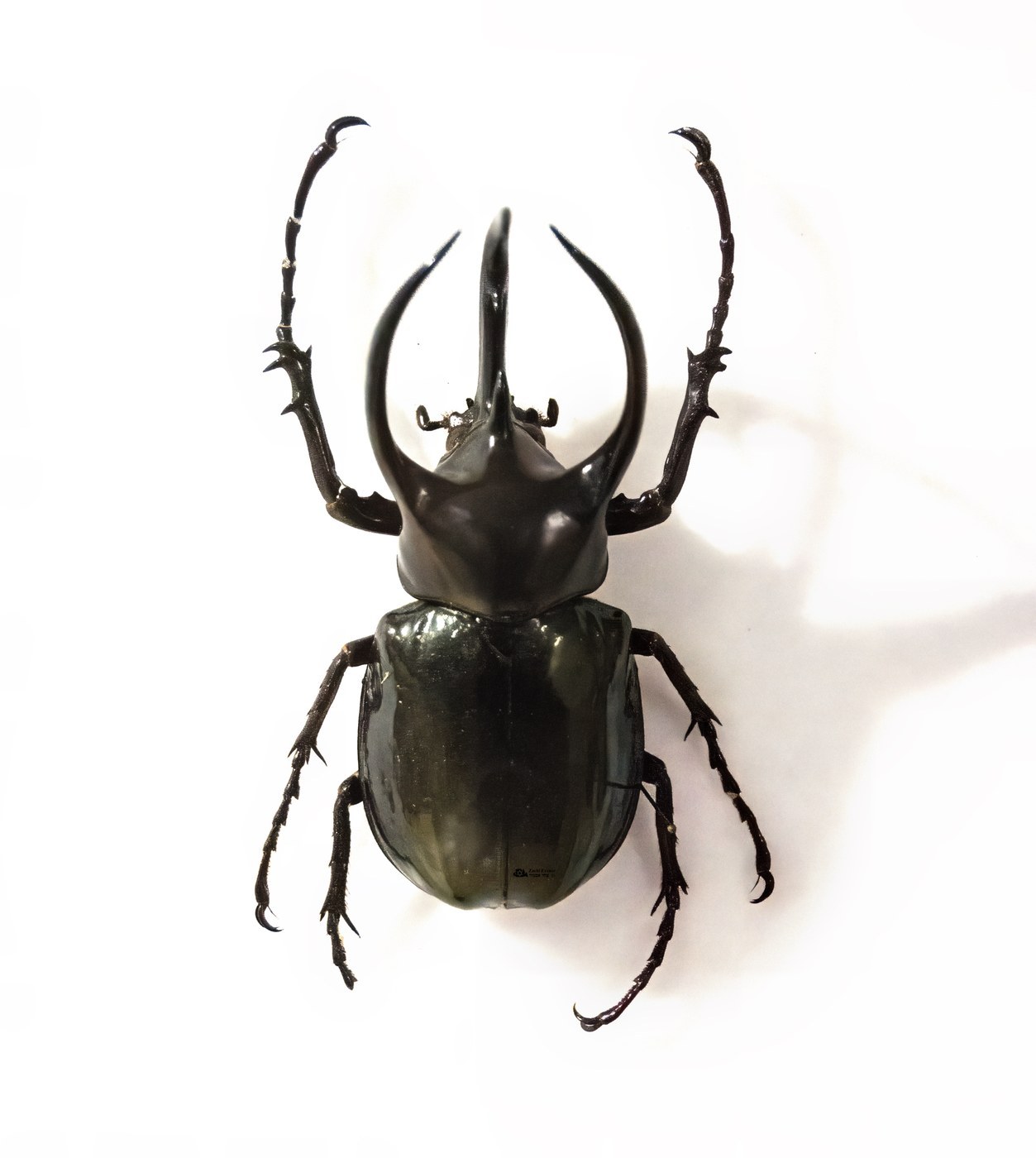
Key Visual Features
The Atlas beetle is a giant rhinoceros beetle recognized by its dramatic horn arrangement:
- Three horns (males): One horn curves upward and forward from the pronotum (thorax), while two shorter horns curve toward each other from the head, forming a claw-like pincer used in combat with rival males.
- Body size: Males can reach 30-120mm long, among the largest beetles by length.
- Coloring: A glossy dark brown to near-black shell, sometimes with a faint greenish or bronze sheen under bright light.
- Females: Hornless, with a rougher, matte, pitted texture and fine short hairs covering the body, quite different from the smooth males.
- Legs: Thick, spiny legs built for climbing and gripping bark.
Where and When You'll See One
Atlas beetles are native to the tropical rainforests of Southeast Asia, including Indonesia, Malaysia, Thailand, and the Philippines. Adults are primarily nocturnal, becoming active after dusk, and are frequently drawn to porch lights and lamps at forest edges. Larvae develop in rotting logs and thick leaf litter on the forest floor, so adults tend to be found near decaying wood.
Similar-Looking Bugs
- Hercules beetle: Also a large rhinoceros-type beetle with horns, but typically has a single long thoracic horn paired with a shorter head horn, rather than the Atlas beetle's three-horn "claw" arrangement.
- Elephant beetle: Shares a bulky rhinoceros beetle build but usually shows a more uniform, less glossy brownish-gray coloring and a different horn shape.
- Other Chalcosoma species: Very close relatives look almost identical; horn curvature and precise proportions are the main distinguishing details.
Behavior Notes
Males are territorial around favored feeding and resting sites on tree trunks, using their three curved horns to grip and flip rival males off a branch during a contest rather than to cause lasting harm. Outside of these bouts, Atlas beetles are generally slow-moving and easy to observe up close once located, especially when resting near a light source after being drawn in overnight.
Quick ID Checklist
- Males show three curved horns forming a pincer shape
- Glossy dark brown to black shell with a possible greenish sheen
- Females are hornless with a rough, hairy, matte texture
- Large body size, often exceeding 60mm in males
- Active at night, often near forest-edge lights
Frequently asked questions
Why do male Atlas beetles have three horns instead of one?
The three-horn arrangement functions like a set of pincers that males use to grip and flip rival males during head-to-head competitions, a feature unique to this genus among rhinoceros beetles.
How do I tell a male from a female Atlas beetle?
Males have the signature three curved horns and a smooth glossy shell, while females are hornless with a rougher, hairier, and duller body surface.
Are Atlas beetles active during the day or at night?
They are mainly nocturnal, becoming active after sunset and often turning up near outdoor lighting near forest habitats.
What is the easiest way to distinguish an Atlas beetle from a Hercules beetle?
Look at the horns: Atlas beetles have three horns forming a claw-like pincer, while Hercules beetles have one long horn on the thorax and one shorter horn on the head, working more like forceps.