
Banana Spider Identification Guide
Learn how to recognize the banana spider by its bold golden webbing and elongated, brightly marked body.
Read the full Banana Spider encyclopedia entry →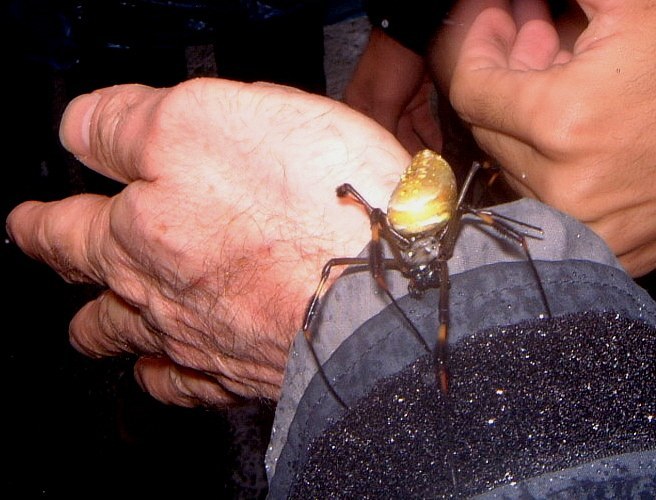
Key Visual Features
The name "banana spider" is applied to a few different large orb-weaving spiders, most commonly the golden silk orb-weaver. Females are the ones you'll notice first because of their size and color:
- Body length: Females typically measure 1-2 inches (body only), with a leg span that can reach 4-5 inches; males are much smaller, often less than a third of the female's size.
- Color pattern: An elongated, cylindrical abdomen marked with bands or patches of yellow, tan, and brown, giving a mottled "banana peel" look.
- Legs: Long, thin legs often tufted with small hairs, banded in brown and orange-yellow, and arranged in pairs that give the spider a distinctive silhouette on its web.
- Web: Perhaps the easiest identifying trait — a huge, golden-tinted, wheel-shaped orb web strung between trees or shrubs, often with a zigzag stabilimentum near the center.
Where and When You'll See One
Banana spiders build large, semi-permanent webs at the edge of wooded areas, along trails, and in gardens, usually in a spot that catches morning or afternoon sun. They are most active and largest in late summer and early fall, after a full season of growth. The webs are typically strung at head height or higher, between two trees or a tree and a structure.
Similar-Looking Spiders
- Garden orb-weavers: Have rounder, more bulbous abdomens without the elongated banana shape, and duller web silk.
- Wood spiders (Argiope species): Show a bold black-and-yellow pattern with a bulkier, angular abdomen and a zigzag web decoration, rather than the smooth golden silk of a true banana spider.
- Huntsman spiders: In some regions the name "banana spider" is used for large, flat-bodied huntsman spiders that hide in leaves rather than build webs — check for a web to tell them apart.
Quick ID Checklist
- Large, elongated abdomen with yellow-brown banding
- Golden-colored, wheel-shaped orb web strung between trees
- Long banded legs held in a distinctive X-shaped resting posture
- Much smaller male often present near the female's web
- Web positioned in a sunny gap at the forest edge or garden border
Frequently asked questions
What makes the banana spider's web different from other spiders' webs?
Its silk has a natural golden or yellow tint, which is why it's sometimes called the golden silk orb-weaver, and the web is unusually large and strong compared to typical garden spider webs.
Why are banana spiders so much bigger than the males near their webs?
Females need extra size to produce large numbers of eggs, while males stay small and mobile so they can travel between webs looking for a mate without drawing attention.
Do banana spiders rebuild their webs every night?
They typically repair and reinforce sections of the same web rather than starting over, which is why their webs look larger and more permanent than many other orb-weaver webs.
Where is the best place to look for a banana spider?
Check sunny gaps at the edge of wooded areas, along garden borders, or between two trees or shrubs where a large golden web can be anchored.