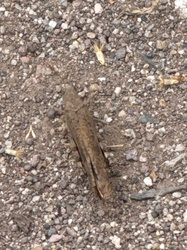
Band-winged Grasshopper Identification Guide
A grasshopper group best recognized by the flash of brightly banded hind wings and a crackling sound in flight.
Read the full Band-winged Grasshopper encyclopedia entry →Key Visual Features
Band-winged grasshoppers (subfamily Oedipodinae) are named for the colorful hind wings that flash into view only when the insect takes flight.
- Size: Small to medium, roughly 0.75-1.75 inches (2-4.5 cm)
- Color: Forewings and body are usually dull brown, gray, or tan with mottled or speckled patterns that provide excellent camouflage against soil and rock
- Body shape: Moderately stocky, typical grasshopper build
- Wings: The hidden hind wings are the standout feature — bright yellow, orange, red, or pink at the base, often with a dark band near the outer edge; these are tucked under the drab forewings at rest and only visible in flight
- Legs: Well-developed jumping hind legs; some species have thickened or ridged hind femurs
- Antennae: Short and stout, much shorter than the body
- Behavior clue: Many species produce a audible crackling or clicking sound (crepitation) while flying, created by snapping the hind wings
Where and When You'd See It
Band-winged grasshoppers favor open, dry, sun-exposed habitats — bare ground, gravel roads, sandy areas, rocky outcrops, and short-grass fields. They are active on warm, sunny days from late spring through fall, often flushing up suddenly underfoot with a burst of color and a crackling sound before landing again a short distance away and vanishing into the background.
Similar-Looking Bugs
- Spur-throated grasshoppers: Lack colorful hind wings and instead have a small spur on the throat; their flight, when it occurs, is quieter and less flashy
- Slant-faced grasshoppers: Have a sharply sloped face and plain, unbanded wings
- Butterflies or moths: Might be mistaken for band-winged grasshoppers in a quick flash of color, but grasshoppers fold their wings and land on the ground rather than fluttering among plants
- Other camouflaged grasshoppers: Without seeing the hind wings in flight, band-winged species can look identical to drab ground-dwelling relatives — flushing them into flight is often the best way to confirm identity
Quick ID Checklist
- Drab, mottled forewings that blend with bare or rocky ground
- Brightly colored hind wings (yellow, orange, or red with a dark band) revealed only in flight
- Crackling or clicking sound produced during flight
- Short, stout antennae
- Found on open, sun-baked, sparsely vegetated ground
Frequently asked questions
Why can't I see the bright color when it's sitting still?
The colorful band is on the hind wings, which stay folded and hidden beneath the plain forewings while at rest — the color only appears during flight.
What is that clicking sound some grasshoppers make?
Many band-winged grasshoppers produce a crackling or clicking sound called crepitation by snapping their hind wings together in flight, a useful clue for identifying the group.
Where is the best place to spot one?
Look on bare soil, gravel paths, rocky ground, or sparse dry grass, where their camouflaged forewings match the surroundings until they take flight.
How is this different from a spur-throated grasshopper?
Band-winged grasshoppers show colorful banded hind wings in flight, while spur-throated grasshoppers have plainer wings and instead carry a small spur on the underside of the throat.
Band-winged Grasshopper identified by the community
Recent Band-winged Grasshopper finds identified with Bug Identifier.