
Banded Hairstreak Identification Guide
A small woodland hairstreak identified by the jagged white-edged band crossing its gray-brown underside.
Read the full Banded Hairstreak encyclopedia entry →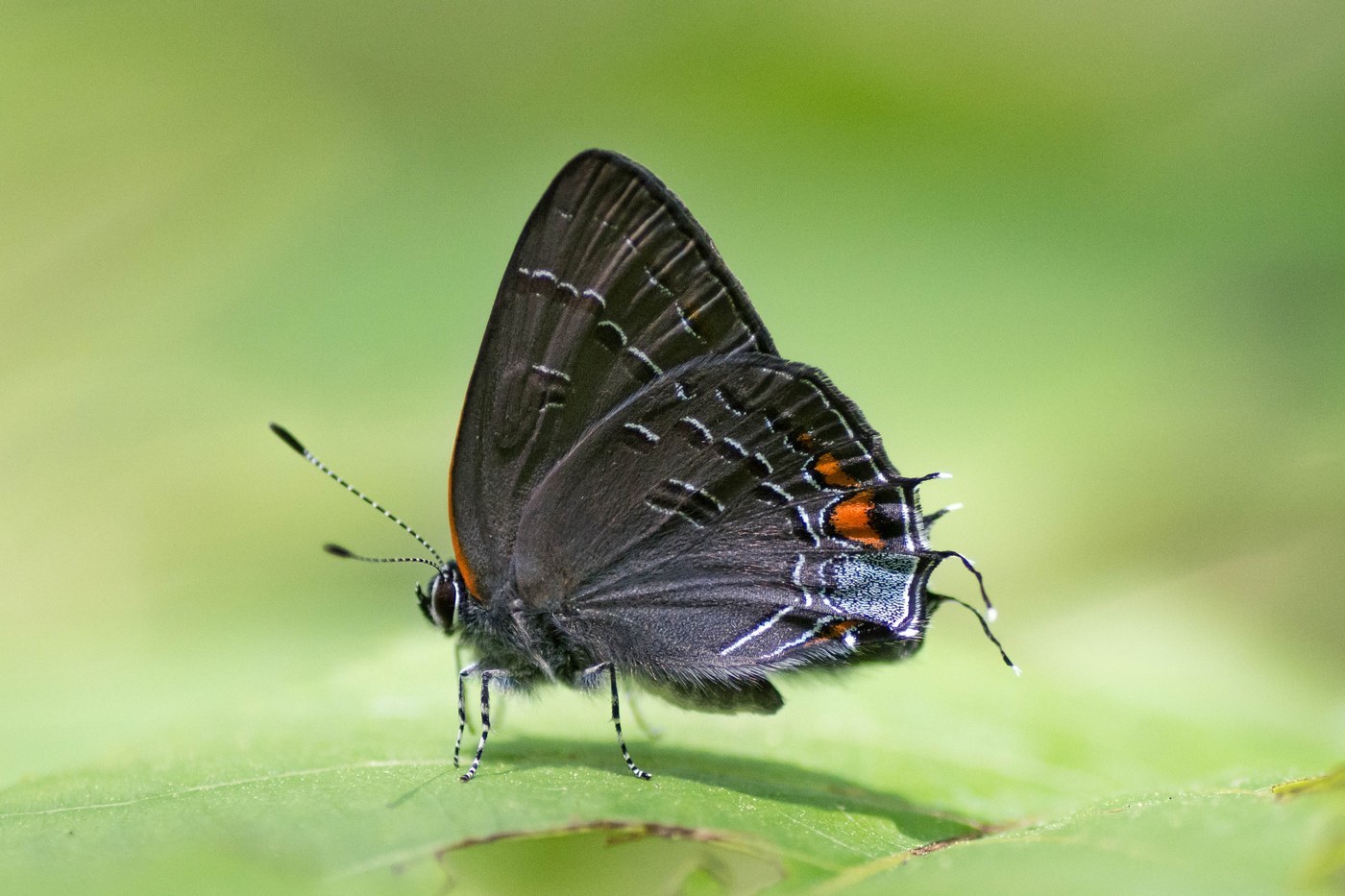
Key Features
The banded hairstreak (Satyrium calanus) is a small butterfly with a wingspan of about 1 to 1.375 inches. Look for these features:
- Upperside is plain brownish-gray with little visible pattern, as with most hairstreaks.
- Underside is gray-brown crossed by a jagged, white-edged dark band (a postmedian band) that runs across both the forewing and hindwing.
- Near the base of the tail there is a small blue spot capped with orange, plus additional scattered small dark markings.
- A thin, hair-like tail extends from the hindwing.
- Wings are small and rounded, and the butterfly often perches with wings closed, slowly rubbing the hindwings together.
Where and When to Spot It
Banded hairstreaks are woodland butterflies, typically found along the edges of oak-hickory forests and other deciduous woodlands across the eastern United States, since their caterpillars feed on hickory, walnut, and oak. They fly in a single generation during midsummer, generally June and July, and are often seen perched on foliage or nectaring on flowers such as milkweed and dogbane at woodland edges and clearings.
Similar Species
The Satyrium hairstreaks are a notoriously difficult group to separate, including Edwards' hairstreak, striped hairstreak, and hickory hairstreak, all of which share a similar size, brown coloring, and banded underside pattern. Careful attention to the exact shape, color, and edging of the band, along with host plant and regional range, is often needed to confirm banded hairstreak specifically. The tailless coral hairstreak is easier to rule out since it lacks a hindwing tail altogether.
Quick ID Checklist
- Small gray-brown hairstreak with a thin hindwing tail
- Jagged, white-edged dark band across the underside of both wings
- Small blue-and-orange spot near the tail base
- Found along oak-hickory woodland edges
- Single midsummer flight, June through July
FAQs
Frequently asked questions
Why is the banded hairstreak considered hard to identify?
It belongs to a group of very similar-looking Satyrium hairstreaks, and distinguishing them often requires close comparison of the underside band shape along with range and host plant.
What trees are associated with banded hairstreak caterpillars?
Hickory, walnut, and oak trees serve as the primary caterpillar host plants, making oak-hickory woodland edges the best places to search.
When is the banded hairstreak active during the year?
It flies in a single generation during midsummer, typically June and July, depending on location.
How does the banded hairstreak differ from the coral hairstreak?
The banded hairstreak has a thin tail on the hindwing and a jagged banded pattern, while the coral hairstreak lacks a tail and instead shows a row of coral-orange spots.