
Banded Woolly Bear Moth Identification Guide
A soft yellow-orange tiger moth, the grown-up form of the familiar black-and-rust banded woolly bear caterpillar.
Read the full Banded Woolly Bear Moth encyclopedia entry →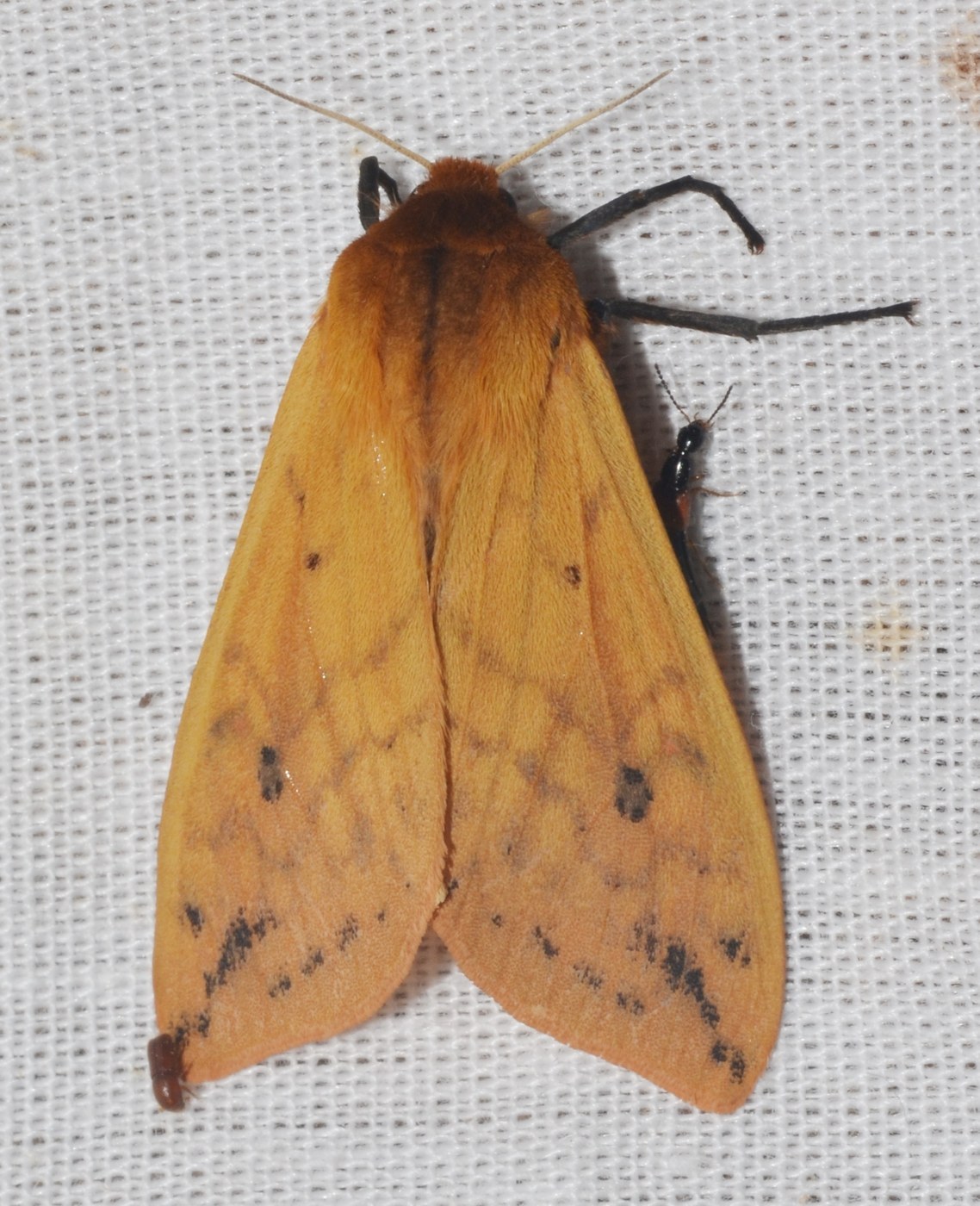
Key Visual Features
The Banded Woolly Bear Moth (the adult stage of the Isabella Tiger Moth) is a medium-sized moth with a wingspan of about 35-50mm.
- Forewings: Dull yellow-orange to tan, sometimes with a faint pinkish tinge, marked with small scattered dark spots concentrated near the wing base and along the margins.
- Hindwings: Paler yellow-orange than the forewings, with fewer or lighter spotting.
- Body: Stout and densely furry, orange-tan overall, with a row of small black dots running along the top of the abdomen.
- Antennae: Slightly feathery in males, simpler in females.
- Overall impression: A soft, evenly speckled, warm tan-orange moth rather than a boldly patterned one.
Where and When You'll See It
Adults are found in fields, gardens, roadsides, and woodland edges, and are nocturnal, coming to lights at night from late spring through summer. This species is far more famous in its larval stage: the woolly bear caterpillar is a densely bristled larva with a black band at each end and a reddish-brown band in the middle, frequently seen crossing roads and paths, especially in autumn as it searches for a sheltered spot to overwinter.
Similar-Looking Species
- Virginia Tiger Moth - pure white wings rather than tan-orange, easily separated by overall color.
- Salt Marsh Moth - shows a bolder black-and-cream spotted pattern and, in males, brighter orange hindwings, compared to the more evenly speckled, softer tan tone of the Banded Woolly Bear Moth.
- Other Grammia/Apantesis tiger moths - tend to show bolder banded or striped forewing patterns, in contrast to the more subtly and evenly speckled look of this species.
Life Cycle & Behavior
This species is unusual in overwintering as a nearly full-grown caterpillar rather than as an egg or pupa, surviving freezing conditions by producing natural antifreeze compounds in its tissues. In spring, the caterpillar resumes feeding briefly before spinning a cocoon incorporating its own bristly hairs and pupating. Adults emerge to mate and lay eggs, with one or two generations occurring per year depending on climate.
Quick ID Checklist
- Medium moth with soft yellow-orange to tan wings
- Small, scattered dark spots concentrated near the wing base and margins
- Stout, furry orange-tan body with a row of black abdominal dots
- Nocturnal, active late spring through summer
- Larva is the famous black-orange-black banded woolly bear caterpillar
Frequently asked questions
Is the Banded Woolly Bear Moth the same insect as the woolly bear caterpillar?
Yes, the black-and-rust banded woolly bear is the larval stage of this species; the adult moth is a soft yellow-orange tiger moth, quite different in appearance from its famous caterpillar.
How do I tell this moth apart from the Virginia Tiger Moth?
The Banded Woolly Bear Moth has tan-orange wings with scattered spotting, while the Virginia Tiger Moth is almost entirely white.
What season are adults most commonly seen?
Adults fly at night mainly from late spring through summer, while the banded caterpillar form is most commonly noticed in autumn.
Where can I find this moth's caterpillar?
The banded woolly bear caterpillar is often seen crossing roads, paths, and open ground, particularly in fall as it looks for a sheltered overwintering spot.