
Brimstone Butterfly Identification Guide
A leaf-shaped, sulphur-yellow butterfly that mimics a leaf at rest and is one of the longest-lived adult butterflies.
Read the full Brimstone Butterfly encyclopedia entry →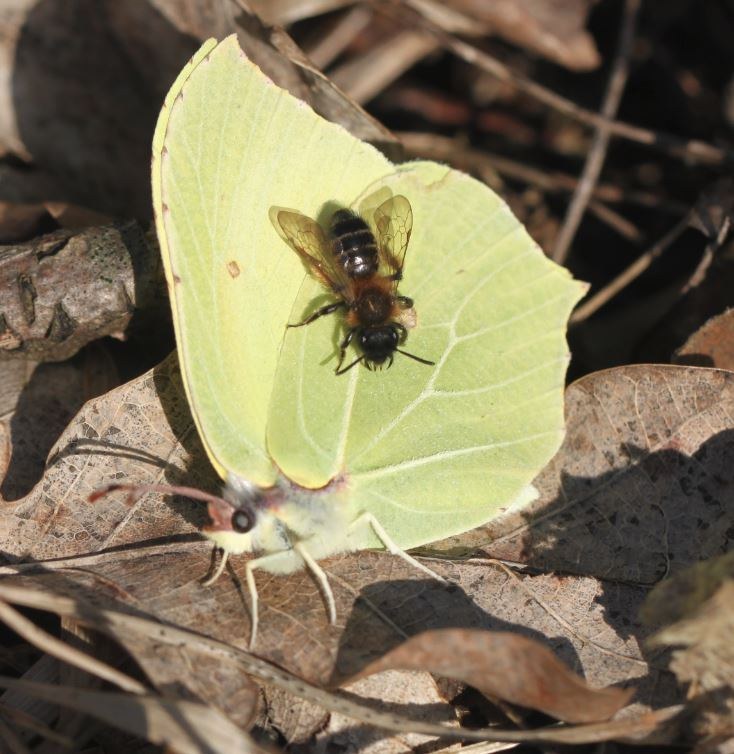
Key Visual Features
The Brimstone (Gonepteryx rhamni) is a distinctive butterfly with a wingspan of about 2.3 to 2.6 inches, easily told from most other species by its wing shape and color.
- Males are a strong, bright sulphur-yellow across both wings
- Females are much paler, appearing pale greenish-white to almost white, which can make them look like a different species at a glance
- Wing shape is highly distinctive: each wing comes to an angular, somewhat pointed tip, and the overall outline closely resembles a leaf, especially the hindwing
- A small orange-brown spot sits near the center of each wing, visible on both upperside and underside
- At rest, the Brimstone always closes its wings, showing only the leaf-shaped, veined underside, which enhances its resemblance to living or dead foliage
- Body is slender and pale, matching the wing tone
Where and When to Look
Brimstones are widespread across Europe, North Africa, and temperate Asia, found in woodland edges, hedgerows, scrub, gardens, and open grassy areas, generally wherever buckthorn (Rhamnus and Frangula species), its host plant, grows nearby. Adults are extremely long-lived for a butterfly, often surviving close to a year, and overwinter as adults hidden among evergreen foliage such as ivy or holly. This gives the species one of the longest flight periods of any butterfly, with sightings possible from very early spring, through summer, and into autumn before winter dormancy begins again.
Similar-Looking Species
- Clouded Yellow: also yellow, but has more rounded wings without the Brimstone's angular, leaf-like points, and shows dark wing borders that the Brimstone lacks
- Cabbage whites (Large White, Small White): white to pale, but have rounded wingtips and black wingtip markings, quite different from the Brimstone's pointed, leaf-shaped silhouette
- Pale female Brimstones vs. whites: female Brimstones can look superficially white-ish, but the pointed wing shape and small orange central spot distinguish them from true white butterflies
Quick ID Checklist
- Angular, leaf-shaped wings with pointed tips
- Males bright sulphur-yellow; females pale greenish-white
- Small orange-brown spot near the center of each wing
- Always rests with wings closed, resembling a leaf
- Found near buckthorn in woodland edges, hedgerows, and gardens across Europe/temperate Asia
Frequently asked questions
How can I tell a male from a female Brimstone?
Males are a bright, strong sulphur-yellow, while females are much paler, appearing pale greenish-white, which can make them resemble a different species at first glance.
Why does the Brimstone look like a leaf?
Its wings are angular with pointed tips, and it always rests with wings closed, showing a veined, leaf-shaped underside that provides camouflage among foliage.
How long do adult Brimstones live?
They are among the longest-lived adult butterflies, often surviving close to a year by overwintering as adults in sheltered vegetation.
What plant should I look near to find Brimstones?
Search near buckthorn shrubs (Rhamnus or Frangula species), which serve as the required host plant for the caterpillars.