
Buff-tip Moth Identification Guide
A master of disguise that folds its wings into the shape of a broken birch twig, complete with matching pale tips.
Read the full Buff-tip Moth encyclopedia entry →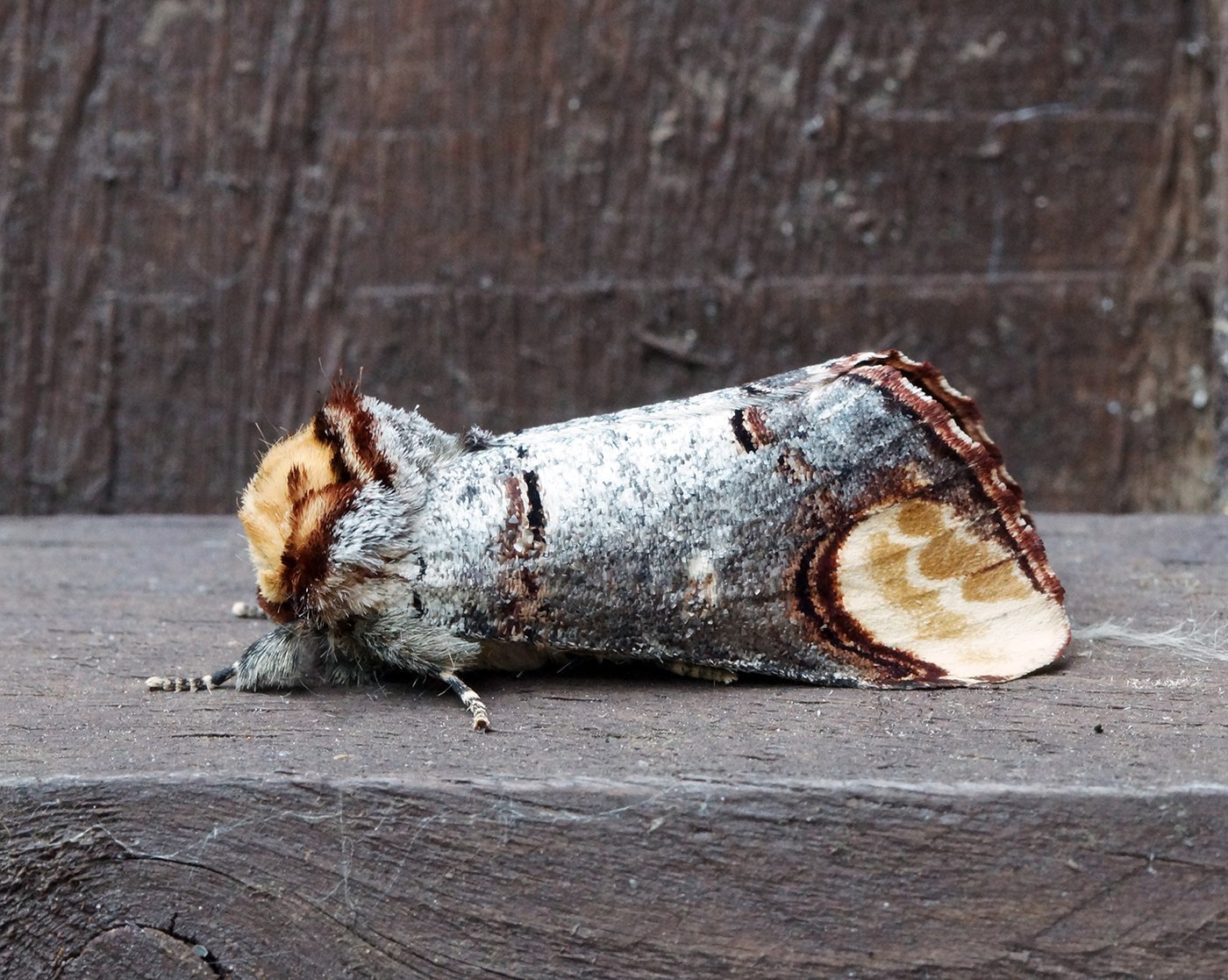
Key Visual Features
The buff-tip moth is one of the best camouflage artists among moths, mimicking a snapped stick:
- Size: Medium to large moth with a wingspan of about 5-6.8 cm (2-2.7 in).
- Color: Silvery gray forewings with fine streaking, resembling weathered bark or wood grain.
- Signature mark: Pale buff-yellow patches at both the head and wingtips, which line up when the wings are folded to mimic the pale broken ends of a twig.
- Body shape: Cylindrical, elongated body held tightly against the folded wings, enhancing the twig-like silhouette.
- Resting posture: Wings rolled around the body rather than flat, and the moth often positions itself at an angle on a branch to complete the disguise.
- Antennae: Thin and feathery, tucked closely against the head when resting.
Where and When You're Likely to See It
Buff-tip moths are found in deciduous woodlands, parks, hedgerows, and gardens with birch, oak, lime, or willow trees, which serve as caterpillar host plants. Adults fly at night from late spring through midsummer and are attracted to outdoor lights and moth traps. During the day, they rest motionless on twigs, branches, or fence rails, where their twig-mimicking shape and coloring make them exceptionally difficult to spot even at close range.
Similar-Looking Moths
- Puss moth: Also grayish and stout-bodied, but lacks the pale buff patches at the head and tail that create the twig illusion.
- Prominent moths in general: Share a similar family resemblance and resting posture, but few match the buff-tip's specific twig camouflage with matching pale ends.
- Lappet moth: Also uses camouflage at rest, but mimics dead leaves rather than a snapped twig, and has a more scalloped wing edge.
Quick ID Checklist
- Silvery gray, wood-grain patterned forewings
- Pale buff patches at both head and wingtips
- Cylindrical body rolled tightly at rest
- Resembles a broken twig when resting on a branch
- Nocturnal, found near deciduous trees
Frequently asked questions
How does the buff-tip moth achieve its twig disguise?
It rolls its wings tightly around its body and positions the pale buff patches at the head and wingtips so they align, mimicking the light-colored broken ends of a snapped twig.
Where is the best place to look for a resting buff-tip moth?
Check twigs and branches on deciduous trees such as birch or oak, scanning for a cylindrical gray shape with pale tips rather than a typical moth silhouette.
Is the buff-tip moth active during the day?
No, it is nocturnal and relies on its twig camouflage to remain undetected by predators while resting through daylight hours.
What time of year can I find buff-tip moths?
They are typically on the wing from late spring through midsummer in temperate regions.