Bumblebee Moth Identification Guide
A day-flying sphinx moth that hovers at flowers and looks so much like a bumblebee it fools most onlookers.
Read the full Bumblebee Moth encyclopedia entry →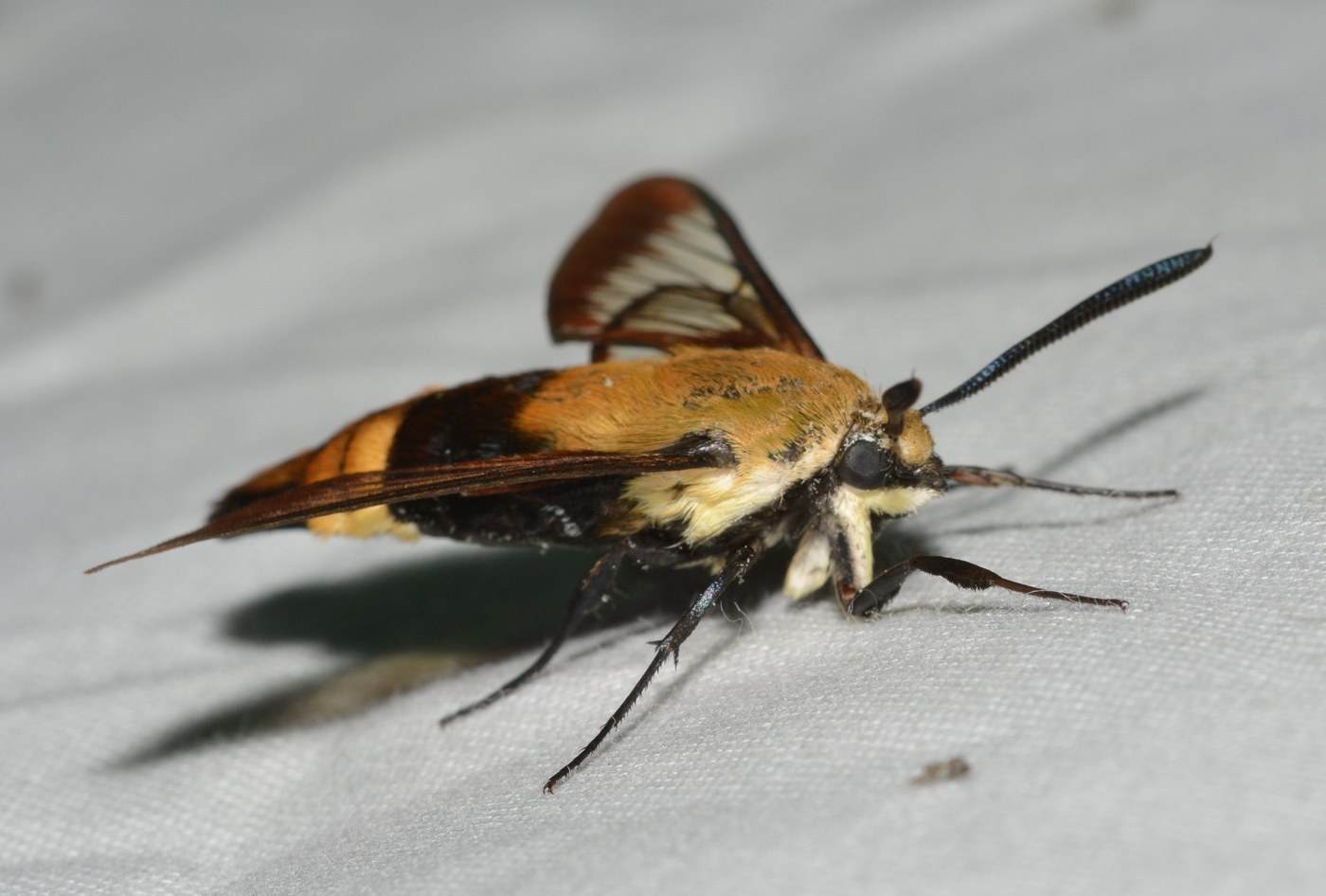
Key Visual Features
The bumblebee moth (a clearwing hummingbird moth) is built to imitate a bumblebee, which makes identification satisfying once you know what to look for:
- Size: Wingspan of about 3.8-5 cm (1.5-2 in), roughly the size of a large bumblebee.
- Wings: Mostly transparent (clear) wings with a dark reddish-brown or olive border, losing their scales soon after the moth emerges.
- Body: Plump, robust body banded in yellow and black or olive-brown and black, mimicking bee coloring.
- Tail tuft: A fan-shaped tuft of hairs at the tip of the abdomen that flares open in flight, resembling a bee's rear end.
- Antennae: Thickened, club-shaped antennae, unlike a bee's thin, elbowed antennae.
- Flight: Rapid, hovering flight with an audible hum, often mistaken for a bee or hummingbird.
Where and When You're Likely to See It
Bumblebee moths are day-fliers, active in bright sunshine, most often seen visiting garden flowers, meadows, and open fields from late spring through summer. They favor tubular flowers such as bee balm, phlox, lilac, and honeysuckle, hovering in front of blossoms while feeding through an extended proboscis, much like a hummingbird. They are rarely seen at night or attracted to lights.
Similar-Looking Insects
- Bumblebees: Lack clear wings and have elbowed, thread-like antennae rather than the moth's clubbed antennae; bees also land on flowers rather than hovering constantly.
- Hummingbird moths (other Hemaris species): Very similar clearwing moths; separating species often requires close attention to the exact color banding, but all share the clear-wing, hovering hummingbird-like behavior.
- True hummingbirds: Much larger, with feathers instead of scales and a rigid bill instead of a coiled proboscis.
Quick ID Checklist
- Clear, scale-free wings with a dark border
- Plump body banded like a bumblebee
- Fan-shaped tail tuft that flares in flight
- Fast, hovering daytime flight at flowers
- Club-shaped antennae (not bee-like elbowed ones)
Frequently asked questions
Is the bumblebee moth actually a bee?
No, it is a moth in the sphinx moth family; its bee-like colors and hovering flight are a form of mimicry that likely helps deter predators.
Why are its wings clear instead of scaly like other moths?
The wing scales are loosely attached and fall off during the moth's first flight after emerging, leaving the transparent wing membrane visible.
When during the day is it most active?
It is most commonly seen feeding at flowers during warm daylight hours, particularly mid-morning to late afternoon.
How do I tell it apart from a hummingbird at a glance?
Look for the smaller size, visible antennae, and fan-like tail bristles rather than feathers; the moth also lacks a hummingbird's slender beak.
Bumblebee Moth identified by the community
Recent Bumblebee Moth finds identified with Bug Identifier.