Cecropia Moth Identification Guide
Identify North America's largest native moth by its crescent wing spots and red-and-white banded body.
Read the full Cecropia Moth encyclopedia entry →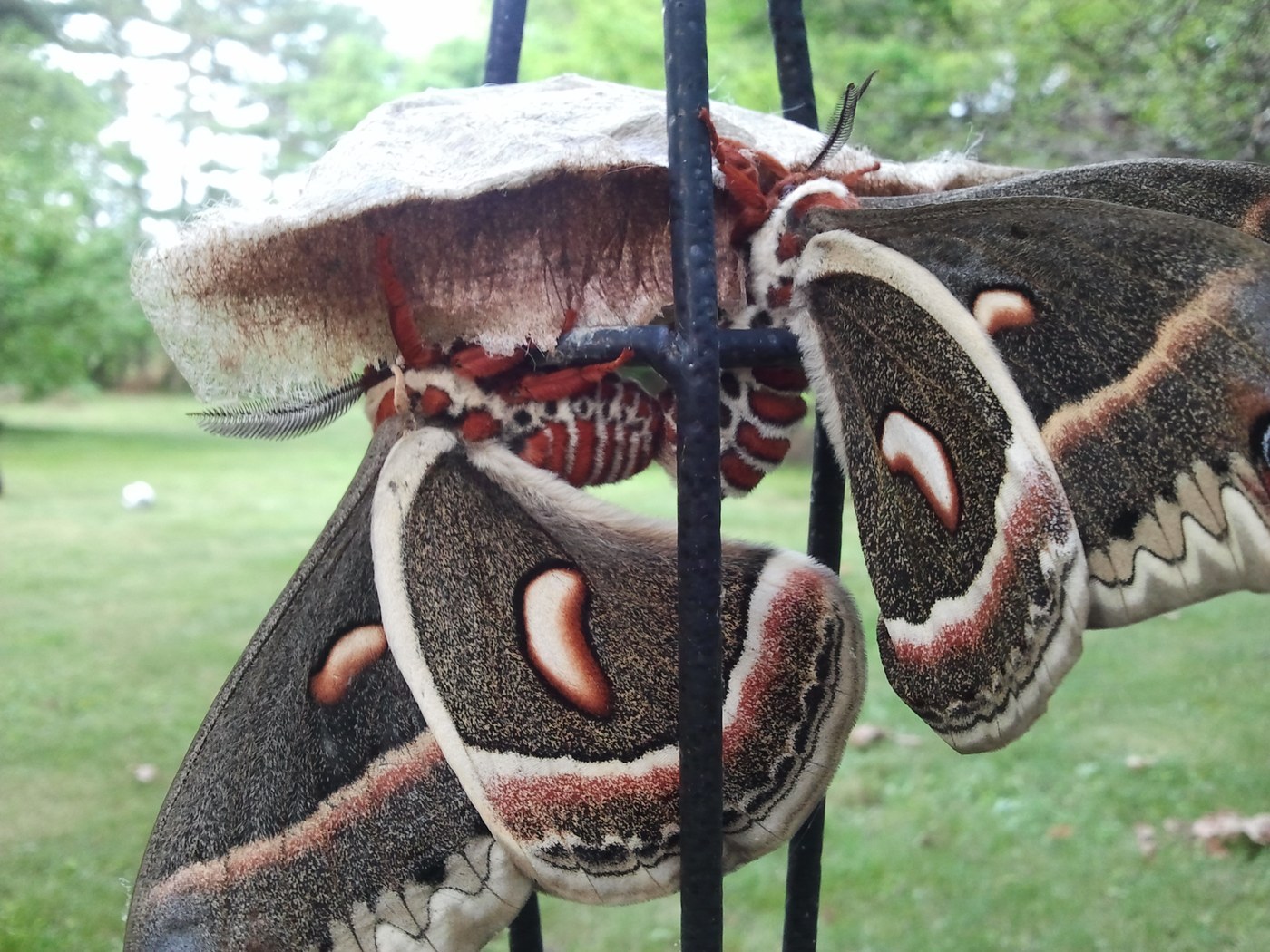
Key Features
- The largest native moth in North America, with a wingspan typically 13–18 cm (5–7 inches)
- Wings are reddish-brown to grayish-brown with a distinctive pattern: each wing has a crescent-shaped white spot near the center, bordered by reddish and black lines, and a wavy band of pale color near the outer margin
- Wing edges (especially the forewing tip) often show a band of reddish and white "eyebrow" marking near the tip, along with a small dark eyespot
- Thick, reddish body with white banding across the abdomen segments, giving a striped appearance from above
- Broad, feathery (plumose) antennae, more pronounced and larger in males, used to detect female pheromones from considerable distances
- No functional mouthparts as adults; the moth does not feed after emerging and survives on reserves from the caterpillar stage
Where & When to Spot One
- Found across most of eastern and central North America, in deciduous woodlands, orchards, and suburban yards with host trees like maple, cherry, birch, and apple
- Adults emerge in late spring to early summer (roughly May–June depending on latitude) and fly for only about one to two weeks before dying
- Strictly nocturnal, most often seen at porch lights, streetlights, or resting on tree trunks and walls near light sources after dark
- Only one generation per year in most of its range, with the species overwintering as a cocoon spun from silk wrapped around a twig
Similar Species
- Polyphemus Moth is similarly large but tan-brown with large transparent eyespots on the hindwings, rather than the crescent-shaped white spots of the Cecropia
- Promethea Moth is smaller and has a different wing shape and coloring, often darker overall with less contrast
- Luna Moth is unmistakable by its pale green color and long tails, making confusion unlikely
- The reddish body with white abdominal bands combined with crescent wing markings is the best way to confirm a Cecropia at a glance
Quick ID Checklist
- Very large size (5–7 inch wingspan)
- Reddish-brown wings with white crescent spots
- Reddish body with white abdominal bands
- Feathery antennae
- Seen near lights on summer nights in eastern/central North America
Frequently asked questions
When are Cecropia Moths active?
Adults fly for a brief window in late spring to early summer and are active only at night.
Why don't Cecropia Moths visit flowers?
Adults have no functional mouthparts and don't feed at all during their short adult life.
How can I tell it apart from a Polyphemus Moth?
Cecropia has crescent-shaped white spots and a red-and-white banded body, while Polyphemus has large clear eyespots on tan wings.
Where is the best place to spot one?
Near outdoor lights or on tree trunks in wooded or suburban areas across eastern and central North America during early summer nights.
Cecropia Moth identified by the community
Recent Cecropia Moth finds identified with Bug Identifier.