
Chinese Oak Silkmoth Identification Guide
Identify this large tan-brown silk moth by its prominent transparent eyespots and gently curved wing shape.
Read the full Chinese Oak Silkmoth encyclopedia entry →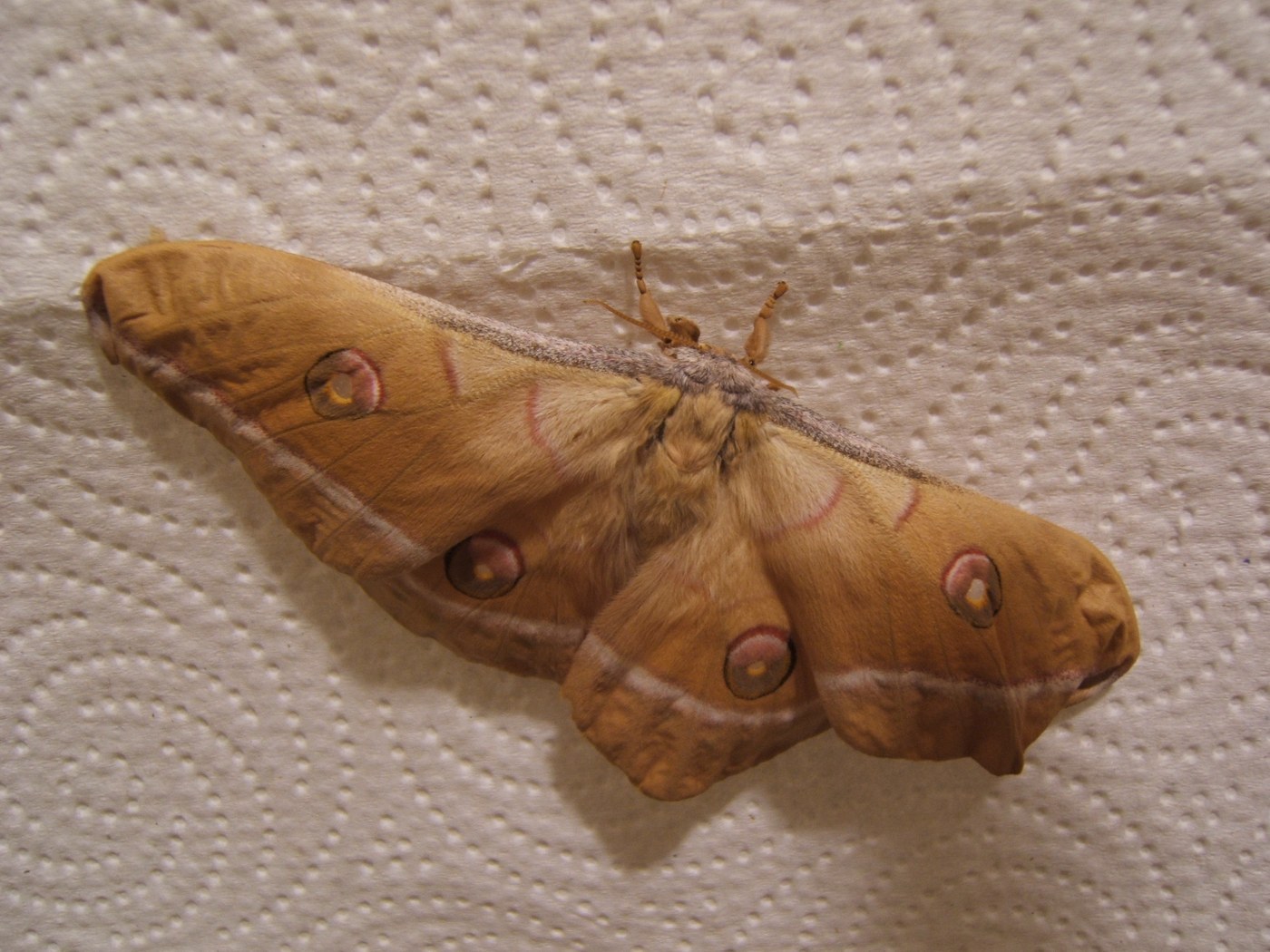
Key Visual Features
The Chinese Oak Silkmoth (Antheraea pernyi) is a large, robust silk moth with a wingspan of about 4 to 6 inches (10 to 15 cm). It shows the classic look of many Saturniidae silk moths:
- Broad, rounded wings in warm tan, rusty-brown, or golden-brown tones, sometimes with a grayish cast
- A prominent, roughly circular to oval transparent "window" eyespot on each of the four wings, usually outlined in black with a yellow or pinkish ring
- A wavy, pale pinkish-tan or lavender-gray band running near the outer edge of both forewings and hindwings
- A stout, densely furry brown body and legs
- Large, feathery (bipectinate) antennae, broader and more comb-like in males than in females
- Gently curved, rounded wing margins without the more angular or hooked tips seen in some related species
At rest, the wings are usually held flat and outspread, prominently displaying all four eyespots, which serve as the main identifying feature.
Where and When You'll See It
This species is native to East Asia, particularly China and Korea, where it is closely associated with oak forests and woodlands, since oak leaves are the primary food source for the caterpillars. It has also been cultivated for silk production in some regions and can be found in areas where it has been reared or has established populations outside strictly wild habitat. Adults are nocturnal, do not feed, and are typically seen in warmer months, generally from late spring through summer, with the exact timing and number of generations varying by region and climate.
Similar-Looking Moths
- Ailanthus Silkmoth (Cynthia Moth): Similar large size and brown tones, but shows simpler pale crescent-shaped markings rather than the Chinese Oak Silkmoth's more rounded, ringed eyespots.
- Polyphemus Moth: A North American relative with comparably bold eyespots, but typically shows more vivid purple-blue coloring within the eyespot rings, differing from the yellow-pink tones typical of the Chinese Oak Silkmoth.
- Indian/Tussar-related Antheraea species: Closely related moths in the same genus that look quite similar; precise range and subtle color differences in the eyespot rings are needed to distinguish them.
Quick ID Checklist
- Large moth, wingspan roughly 4–6 inches, tan to rusty-brown wings
- Prominent transparent eyespot on each wing, ringed in black and yellow/pink
- Wavy pale band near the outer wing margin
- Feathery antennae, broadest in males
- Associated with oak woodlands in East Asia, active at night in late spring through summer
Frequently asked questions
What is the best feature to identify a Chinese Oak Silkmoth?
The large, roughly circular transparent eyespot on each wing, outlined in black with a yellow or pinkish ring, is the most reliable identifying feature of this species.
Why is oak important for finding this species?
Oak leaves are the primary food source for the caterpillars, so adults and evidence of the species are most often associated with oak forests and woodlands within its native East Asian range.
How does this species differ from the related Polyphemus Moth?
Both have bold wing eyespots, but the Polyphemus Moth's eyespots typically show more vivid purple-blue coloring, while the Chinese Oak Silkmoth's eyespots tend toward yellow and pink tones.
When are adults of this species most active?
Adults are generally seen at night during the warmer months, roughly late spring through summer, though exact timing depends on regional climate and generation cycles.