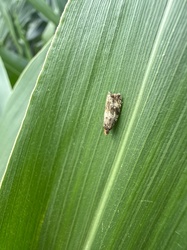
Codling Moth Identification Guide
Learn to recognize this small orchard moth by its coppery wingtip patch and roof-shaped resting posture.
Read the full Codling Moth encyclopedia entry →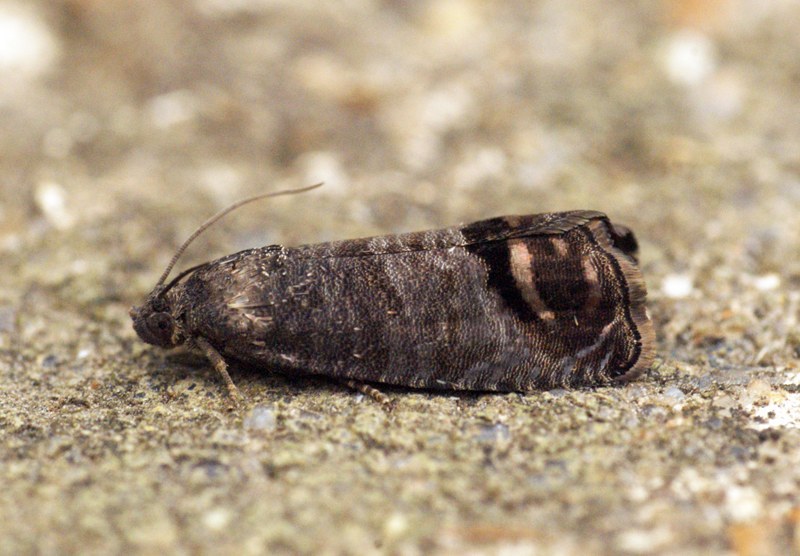
Key Visual Features
The codling moth is a small, easy-to-overlook moth unless you know what to look for.
- Size: Wingspan of about 15-20mm (roughly 3/4 inch).
- Color and pattern: Forewings are mottled gray-brown with fine wavy lines, with a standout coppery-bronze patch (ocellus) near the tip of each forewing, edged in dark metallic lines.
- Body shape: Slender, grayish body that blends with tree bark.
- Wings: Held folded in a tent- or roof-like posture over the body at rest, giving the moth the look of a curled bit of bark or bud scale.
- Legs and antennae: Legs are thin and inconspicuous; antennae are thread-like and moderate in length, usually held forward or swept back close to the body when resting.
Where and When You'll See It
Codling moths are closely tied to apple, pear, and walnut trees, so look for them in orchards, backyard fruit trees, and gardens with these plantings. Adults are most active at dusk and into the night, flying around host trees to mate and lay eggs. During the day they rest motionless on bark or in bark crevices and among foliage, relying on their mottled coloring for camouflage against watchful eyes and predators alike. They're present from spring through late summer, with multiple overlapping generations in warmer climates and a single generation in cooler regions.
Similar-Looking Moths
Several small tortricid ("leafroller") moths share the same general gray-brown, tent-winged look and can be mistaken for codling moth at a glance, especially in poor light. The coppery-bronze wingtip patch is the most reliable way to separate codling moth from lookalikes such as oriental fruit moth, which is smaller overall and lacks a bold bronze patch, showing instead plain gray-brown wings with faint mottling. Leafroller moths in general tend to have plainer, more uniformly mottled wings without that distinct metallic marking, and many hold their wings in a flatter, less peaked roof shape at rest.
Quick ID Checklist
- Small mottled gray-brown moth, about 2cm across
- Coppery-bronze patch near each forewing tip
- Wings folded roof-like at rest, resembling bark
- Found on or near apple, pear, or walnut trees
- Most active at dusk and after dark
Frequently asked questions
How do I tell a codling moth from other small orchard moths?
Look for the coppery-bronze patch near the wingtip; most similar small gray moths lack this marking.
What time of day are codling moths active?
They are most active at dusk and into the night, resting hidden during daylight hours.
Where do codling moths rest during the day?
On bark or among foliage near host trees, where their gray coloring provides camouflage.
Do codling moths look different from their caterpillars?
Yes, the adult is a small gray-brown moth, quite different in appearance from the pinkish-white caterpillar stage.
Codling Moth identified by the community
Recent Codling Moth finds identified with Bug Identifier.