
Comet Moth (Madagascan Moon Moth) Identification Guide
One of the largest and most spectacular silk moths in the world, instantly recognizable by its long, ribbon-like tails.
Read the full Comet Moth (Madagascan Moon Moth) encyclopedia entry →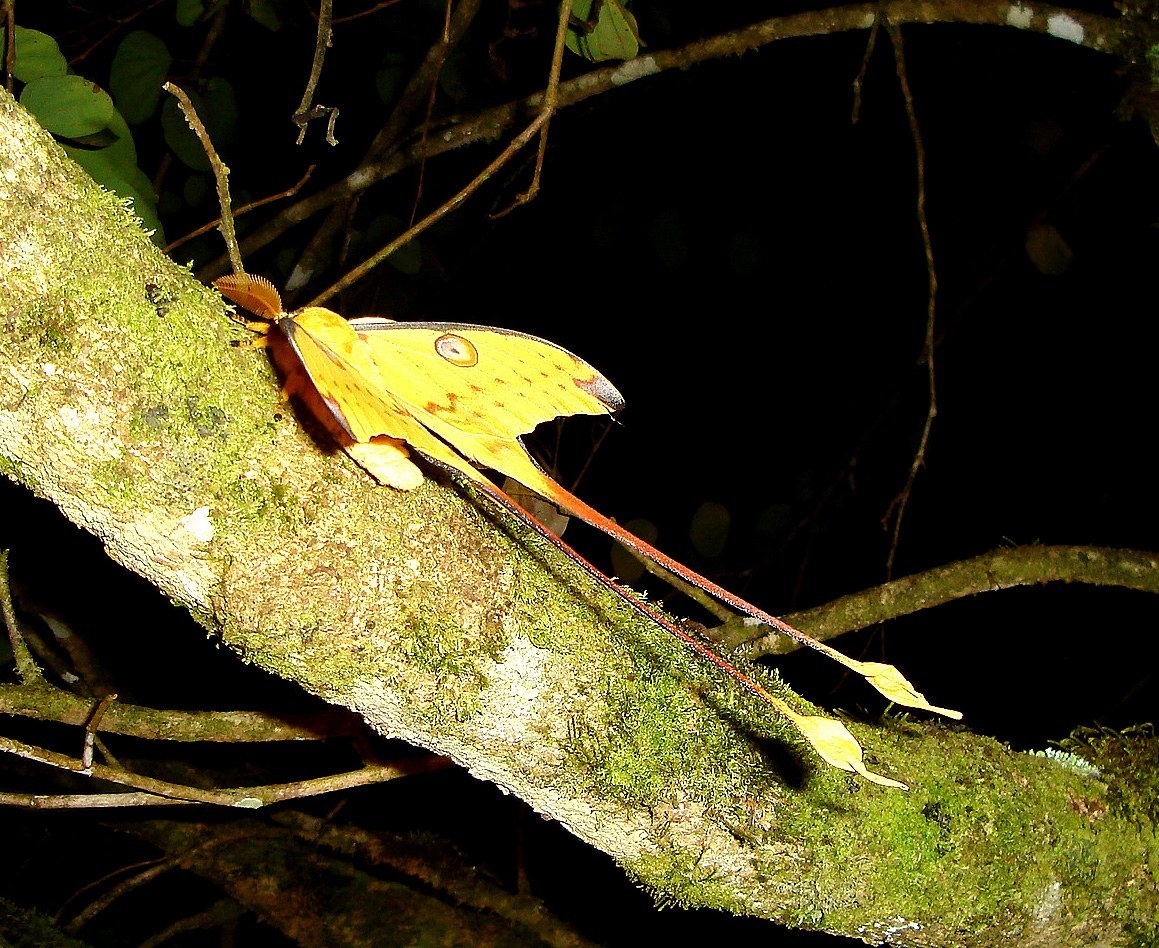
Key Visual Features
The comet moth is one of the biggest and most dramatic members of the silk moth family. Look for these traits:
- Size: Wingspan often reaches 14-20 cm (5.5-8 in), among the largest moths on Earth.
- Color: Rich yellow to orange-red wings, often with a reddish-brown wash near the wing bases.
- Tails: The single most diagnostic feature — long, twisted, ribbon-like tails trailing from the hindwings, sometimes as long as the moth's body.
- Eyespots: Each wing bears a translucent, crescent-shaped eyespot outlined in black, pink, and yellow.
- Body: Thick, furry, reddish-brown body with large, feathery (bipectinate) antennae, especially bushy in males.
- Legs: Short and hairy, mostly hidden by the dense body fur.
Where and When You're Likely to See It
This species occurs only in the rainforests of Madagascar, so sightings outside the island are almost always captive-bred specimens in butterfly houses and insectariums. In the wild it favors humid montane and lowland forest. Adults fly at night and are strongly drawn to artificial light, but because the adult has no functional mouthparts, its flying life lasts only a few days after emerging from the cocoon. Sightings peak during the warm, wet months when cocoons hatch.
Similar-Looking Moths
- Other Saturniid (silk) moths: Many giant silk moths share the large eyespots and feathery antennae, but few have tails this long and ribbon-like.
- Luna moth: Also has long tails and pale coloring, but the luna moth is pale green, not yellow-orange, and is native to North America rather than Madagascar.
- Emperor moths: Related species have similar wing shape and eyespots but lack the extreme tail length.
Quick ID Checklist
- Extremely long, twisted tails on the hindwings
- Large wingspan (hand-sized or bigger)
- Golden-orange to reddish wing color
- Translucent crescent eyespot on each wing
- Feathery antennae, bushiest in males
Frequently asked questions
How can I tell a male from a female comet moth?
Males have noticeably larger, bushier feathery antennae used to detect female pheromones, while females have thinner antennae and typically a bulkier abdomen.
Why do comet moths only live a few days as adults?
Adults lack functional mouthparts and cannot feed, so they survive on energy reserves stored during the caterpillar stage, limiting adult life to about four to five days.
Are the tails fragile?
Yes, the long hindwing tails are delicate and often become torn or shortened on wild specimens after a few nights of flight, so pristine long-tailed individuals are usually freshly emerged.
Can I find this moth outside Madagascar?
In the wild, no — it is endemic to Madagascar's forests; any specimens seen elsewhere are typically captive-reared in zoos or insect exhibits.