
Common Ringlet Identification Guide
A small, plainly patterned grassland butterfly recognized by its soft orange-gray tones and faint underside banding.
Read the full Common Ringlet encyclopedia entry →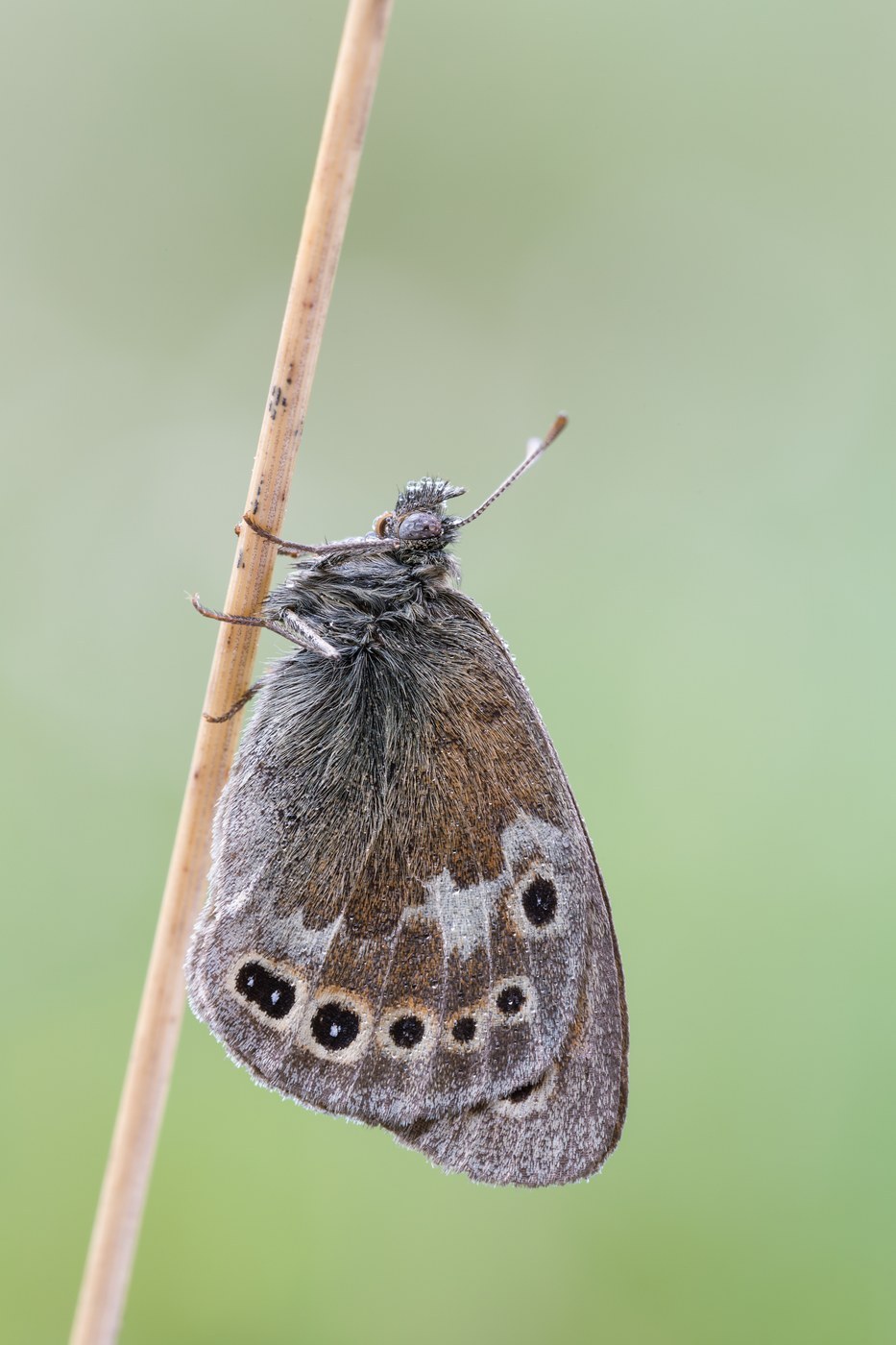
Key Visual Features
The Common Ringlet (Coenonympha tullia) is a small, understated butterfly with a wingspan of about 1.3 to 1.7 inches, lacking the bold markings of many other satyrs.
- Upperside ranges from pale orange-brown to grayish-brown depending on the population, often with little to no obvious pattern
- A small, faint eyespot may appear near the tip of the forewing, but in many populations it is reduced to a tiny dot or absent altogether
- Underside of the hindwing is grayish-tan and typically shows a fine, pale, somewhat wavy postmedian line or band crossing the wing, along with occasional tiny eyespots
- Wings are rounded and the body is slender, with unremarkable brown-gray coloring
- This species is notably variable across its broad range, with numerous regional forms differing in exact tone and the presence of the faint eyespot
Where and When to Look
Common Ringlets favor open, grassy habitats: prairies, meadows, roadside verges, pastures, and open woodland clearings. The species has an extremely wide distribution across northern North America (much of Canada and the northern/western U.S.) and also occurs across northern Eurasia. It has a low, weak, fluttering flight close to grass level and rarely strays far from open ground. Depending on latitude, there can be one to several broods, with adults appearing anywhere from mid-spring through fall.
Similar-Looking Species
- Common Wood-Nymph: much larger with bold, obvious eyespots on the forewing set in a yellow patch, unlike the Ringlet's plain, muted appearance
- Little Wood-Satyr: also small, but shows two clear, bold eyespots per wing, whereas the Common Ringlet's eyespots (if present at all) are tiny and faint
- Other small satyrs in general: the Common Ringlet's overall plainness, soft grayish-orange tone, and faint underside band are usually enough to separate it once size and pattern are compared side by side
Quick ID Checklist
- Small, plain orange-gray to grayish-brown butterfly
- Faint or absent eyespot near forewing tip
- Pale wavy band on grayish-tan hindwing underside
- Weak, low, fluttering flight over grass
- Found in open grassy habitats across a very wide northern range
Frequently asked questions
Why does the Common Ringlet look so plain compared to other satyrs?
It generally lacks the bold eyespots and strong patterning of relatives like the Wood-Nymph or Wood-Satyr, showing instead a soft, muted orange-gray tone with only a faint pale band on the underside.
Does the Common Ringlet always have an eyespot on the forewing?
Not always; the eyespot is highly variable across its many regional forms and can be reduced to a tiny dot or missing entirely in some populations.
How wide is the range of the Common Ringlet?
It is one of the most widely distributed satyrs, found across much of northern North America and also across northern Eurasia, with considerable regional variation in appearance.
What habitat should I check to find this butterfly?
Open, grassy places such as prairies, meadows, pastures, and roadside verges are the most reliable habitats.