Common Whitetail Dragonfly Identification Guide
Recognize the Common Whitetail Dragonfly by the mature male's chalky white abdomen and its wings marked with broad, dark bands.
Read the full Common Whitetail Dragonfly encyclopedia entry →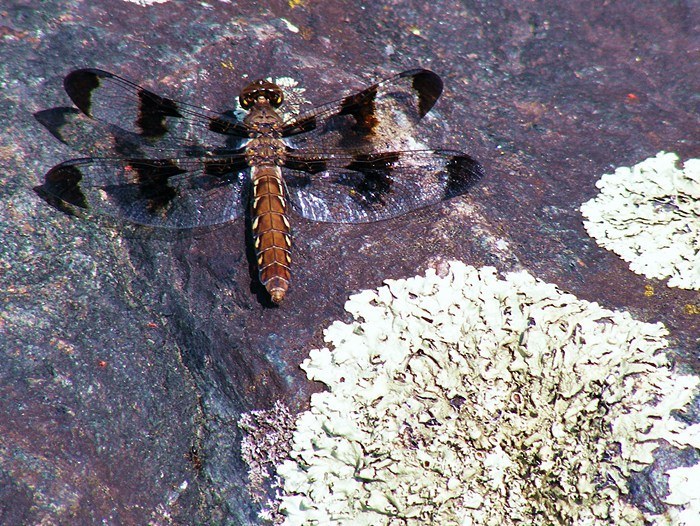
Key Visual Features
The Common Whitetail Dragonfly is a medium-sized dragonfly, generally 1.7 to 2 inches long, easily recognized by its short, stout, powder-white abdomen in mature males.
- Abdomen: In mature males, wide, flattened, and coated in a chalky white pruinescence that gives it the "whitetail" name; females and immature males instead show a brown abdomen with a pattern of pale yellow spots along the sides.
- Wings: Broad, dark brown to black bands cross each wing roughly in the middle, a key identifying feature present in both sexes, though the exact wing pattern differs slightly between males and females.
- Thorax: Brownish and relatively unmarked compared to the boldly patterned abdomen and wings.
- Head: Large eyes that meet broadly at the top of the head, typical of dragonflies, with a dark face.
- Body shape: Stocky and short compared to darners, with a notably broad, flattened abdomen rather than a slender, elongated one.
Where and When You'd See It
Common Whitetail Dragonflies are found near ponds, lakes, slow streams, and marshy areas, often perching on open ground, rocks, or low vegetation near the water's edge rather than flying continuously. They are active during the day in warm weather, commonly seen from late spring through summer, and are known for frequent, low, gliding flights interspersed with perching periods where they rest with wings held flat. Males often perch prominently and defend territories along the shoreline, making the white abdomen easy to spot from a distance.
Similar-Looking Bugs
Common Whitetail Dragonflies can be confused with:
- Twelve-spotted skimmer – A related species with wings marked by multiple dark bands and white spots between them, giving a more complex banded wing pattern compared to the whitetail's simpler dark band.
- Other whitetail or skimmer species – Some related skimmers show a pale abdomen, but differ in wing band placement, body size, or the extent of the abdomen's white coloring.
- Female Common Whitetails vs. other brown-bodied dragonflies – Females lack the white abdomen and can resemble other spotted-abdomen skimmer species, requiring close attention to the wing band pattern for confirmation.
- Widow skimmer – Also has dark wing bands, but with an additional pale or white patch near the wing base in mature males, unlike the whitetail's plain dark band without an added pale patch.
Quick ID Checklist
- Broad, chalky white abdomen in mature males
- Brown abdomen with pale side spots in females and young males
- Bold dark band crossing the middle of each wing
- Short, stocky body shape with a flattened abdomen
- Frequently perches on open ground or low rocks near water, rather than flying continuously
Frequently asked questions
Why is only the male's abdomen white?
The chalky white coloring, called pruinescence, develops as males mature, while females and young males retain a brown abdomen marked with pale yellow spots along the sides.
How can I tell a Common Whitetail from a Twelve-spotted Skimmer?
The Twelve-spotted Skimmer has a more complex wing pattern with multiple dark bands and white spots between them, while the Common Whitetail shows a single, simpler dark band across each wing.
What is the easiest way to identify a female Common Whitetail?
Look for a brown abdomen with a row of pale yellow spots along the sides, combined with the single dark band crossing each wing, since females lack the white abdomen of mature males.
Where is the best place to spot a Common Whitetail Dragonfly?
Check open ground, rocks, or low vegetation near ponds, lakes, and slow streams, since this species perches frequently near the water's edge rather than flying continuously like some other dragonflies.
Common Whitetail Dragonfly identified by the community
Recent Common Whitetail Dragonfly finds identified with Bug Identifier.