Cone-headed Katydid Identification Guide
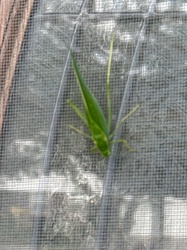
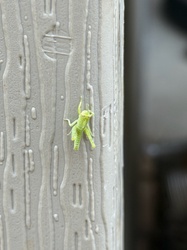
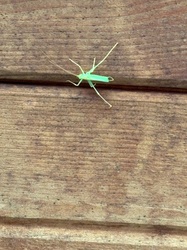
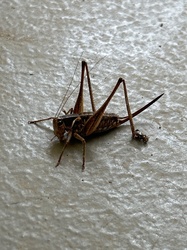
Spot the Cone-headed Katydid by its unmistakable cone- or spike-shaped head extension projecting forward above the antennae.
Read the full Cone-headed Katydid encyclopedia entry →Key Visual Features
The Cone-headed Katydid is a large, elongated katydid, often 2 to 3 inches long, named for the distinctive cone- or spike-like projection extending forward from the top of its head.
- Body: Long and slender, typically green or tan-brown, sometimes with a stripe running down the back, built for blending into tall grasses and reeds.
- Head: The defining feature is a pointed, cone-shaped extension projecting forward above the face, giving the head a sharply tapered, almost horned appearance.
- Wings: Long, narrow forewings extending well past the abdomen, held flat and overlapping along the back at rest, unlike the tent-like posture of leaf-mimicking katydids.
- Antennae: Extremely long and thread-thin, often several times the length of the body.
- Legs: Long and slender, with enlarged hind legs adapted for jumping.
Where and When You'd See It
Cone-headed Katydids are found in tall grasses, meadows, marshes, and weedy fields, where their elongated shape and coloring blend in among grass blades and reeds. They are most active at night, when males produce loud, buzzing or clicking calls from within dense grass, and are typically encountered from mid to late summer into early fall. During the day they remain hidden low in vegetation, making their calls a more reliable way to detect their presence than direct sighting.
Similar-Looking Bugs
Cone-headed Katydids can be confused with:
- True katydids – Leaf-mimicking katydids have broad, rounded, leaf-shaped wings and lack the pointed head projection.
- Meadow grasshoppers – Some slender grasshoppers share the elongated grass-like body, but have short, thickened antennae and a rounded head without a cone.
- Other cone-headed species – Multiple related species share the cone-shaped head but differ in body color, size, and the exact shape or length of the head projection.
- Walkingsticks – Walkingsticks are even more elongated and lack wings entirely in many species, along with lacking the katydid's long antennae and jumping legs.
Quick ID Checklist
- Distinctive cone- or spike-shaped projection on top of the head
- Long, slender, grass-colored body (green or tan-brown)
- Antennae far longer than the body, thread-thin
- Narrow wings held flat and overlapping, extending past the abdomen
- Found low in tall grass or marsh vegetation, most active and vocal at night
Frequently asked questions
What is the most reliable feature for identifying a Cone-headed Katydid?
The forward-pointing, cone- or spike-shaped projection on top of the head is the clearest identifying feature and is not found on other common katydids or grasshoppers.
How do Cone-headed Katydids differ from leaf katydids?
Leaf katydids have broad, rounded, leaf-shaped wings and a normal rounded head, while cone-headed katydids have narrower, flatter wings and the signature pointed head extension.
Where is the best place to look for one?
Check tall grasses, meadows, and marshy or weedy fields, since their elongated, grass-colored bodies allow them to blend in closely with grass blades and reeds.
Why is it easier to hear a Cone-headed Katydid than to see one?
They are most active at night and remain low and hidden within dense grass during the day, so their loud buzzing or clicking calls are often the first sign of their presence.
Cone-headed Katydid identified by the community
Recent Cone-headed Katydid finds identified with Bug Identifier.