
Corn Earworm Moth Identification Guide
A tan to olive-colored moth with a dark kidney-shaped spot on each forewing, commonly seen fluttering near crop fields at dusk.
Read the full Corn Earworm Moth encyclopedia entry →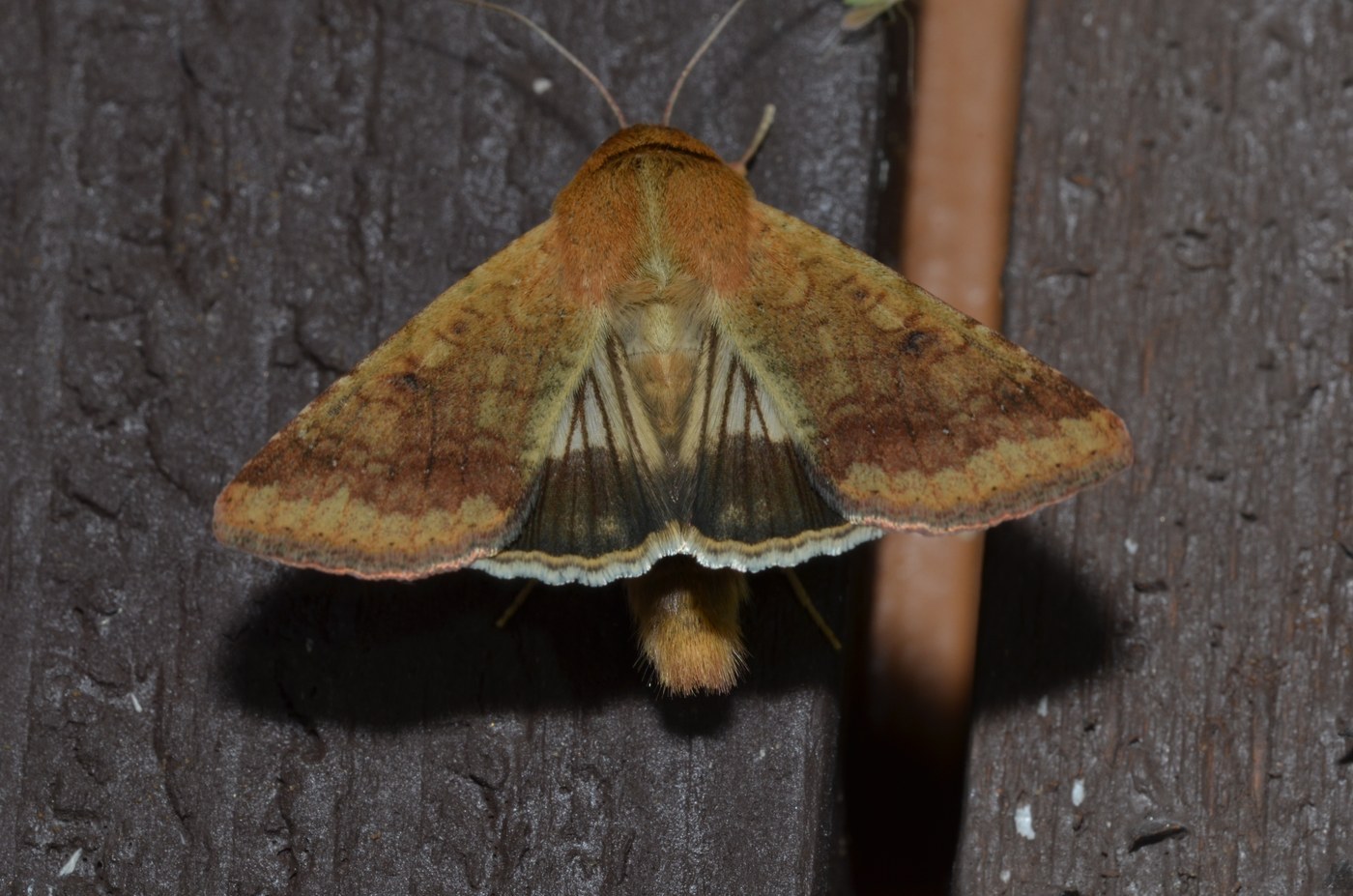
Key Visual Features
The corn earworm moth has variable but recognizable coloring:
- Size: Medium moth with a wingspan of roughly 3.2-4.5 cm (1.3-1.8 in).
- Color: Forewings range from light tan or buff to olive-green or pinkish-brown, varying by individual.
- Markings: A dark, irregular kidney-shaped (reniform) spot near the center of each forewing, along with a faint dark band near the outer edge.
- Hindwings: Pale cream to whitish with a dark border and a dark spot, visible when the moth is in flight or startled.
- Body: Moderately stout, covered in fine scales matching the forewing tone.
- Antennae: Thin, thread-like, typical of owlet moths.
Where and When You're Likely to See It
This moth is widespread across farmland, gardens, and open country, especially near corn, tomato, and other row crops. Adults are active mainly at dusk and through the night, and are strong fliers capable of migrating long distances on wind currents. They are commonly drawn to porch lights, floodlights, and light traps. Sightings peak in summer through early fall, with multiple generations possible in a single season in warmer regions. During the day they rest hidden among foliage or in field debris.
Similar-Looking Moths
- Tobacco budworm moth: Nearly identical in size and coloring; the two are best separated by subtle differences in the forewing band pattern, which can be difficult without close comparison.
- Armyworm moths: Generally have a more uniform grayish-brown forewing without the distinct kidney-shaped spot.
- Cabbage looper moth: Smaller, with a silvery figure-eight mark rather than a solid dark kidney spot.
Quick ID Checklist
- Tan to olive-green forewings, color varies by individual
- Dark kidney-shaped spot mid-forewing
- Pale hindwings with a dark border
- Active at dusk and night near crop fields
- Strong, migratory flier
Frequently asked questions
Why does the corn earworm moth's color vary so much?
Individual coloring ranges naturally from tan to olive to pinkish-brown, which is normal variation within the species rather than a sign of different moths.
What is the best single feature to confirm identification?
The dark, irregular kidney-shaped spot near the center of each forewing is the most consistent identifying mark, even when overall color varies.
Is this moth found only near corn?
No, despite the name it is found in many types of open habitat and is attracted to a wide range of flowering and crop plants, not corn exclusively.
How far can this moth travel?
Adults are strong fliers known for long-distance seasonal movements, sometimes carried hundreds of miles by prevailing winds.