Cutworm Identification Guide
Learn to identify this smooth, plump moth larva by its dull coloring, curled resting posture, and habit of hiding in soil by day.
Read the full Cutworm encyclopedia entry →Key Visual Features
Cutworms are the larvae of various night-flying moths (family Noctuidae), recognized by their smooth, thick bodies and secretive, soil-dwelling habits.
- Size: Typically 1 to 2 inches long when fully grown.
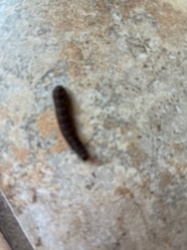
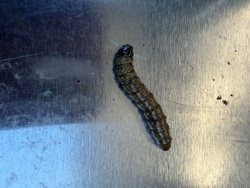
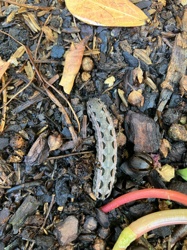
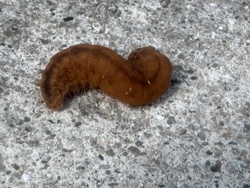
- Color: Dull and often drab — gray, brown, tan, or black, sometimes with faint stripes, spots, or mottling running the length of the body; coloring tends to blend with soil.
- Body shape: Smooth, plump, cylindrical body without the dense hair of woolly caterpillars; skin has a somewhat greasy or shiny appearance.
- Legs: Three pairs of true legs near the front and several pairs of fleshy prolegs toward the rear, typical of moth larvae.
- Head: Small, rounded, and usually darker than the body.
- Behavior: The most distinctive identifying trait is its posture — when disturbed or at rest, a cutworm curls tightly into a C-shape or tight coil rather than remaining straight.
Where and When You'd See One
Cutworms live in soil and leaf litter around gardens, lawns, and agricultural fields, hiding just below the surface or under debris during the day. They are nocturnal feeders, emerging after dark to feed near the soil line, then retreating underground before daylight. They are most commonly encountered in spring and early summer when larvae are actively feeding, and are typically found by digging in soil near affected plants rather than seen openly during the day.
Similar-Looking Bugs
- Armyworms: Closely related noctuid larvae, but tend to show more distinct longitudinal stripes and feed more openly on foliage above ground in groups, rather than hiding below the soil surface singly.
- Woolly bear caterpillars: Covered in dense, bristly hair and show a bold banded pattern, unlike a cutworm's smooth, dull, hairless skin.
- Grubs (beetle larvae): Have a distinct C-shaped curl too, but possess a hardened, distinct head capsule with visible chewing mandibles, three pairs of short true legs only (no fleshy prolegs), and a whitish, soft, wrinkled body rather than a smooth cylindrical moth-larva body.
- Loopers (inchworm-type caterpillars): Move with a distinctive arching, looping gait due to missing middle prolegs; cutworms have a full complement of prolegs and crawl normally rather than looping.
Quick ID Checklist
- Smooth, plump, hairless body in dull gray, brown, or tan tones
- Curls tightly into a C-shape when disturbed or at rest
- Small, rounded, darker head
- Found hidden in soil or under debris by day, feeds at night
- Most common in spring and early summer near garden or field plants
Frequently asked questions
What is the easiest way to identify a cutworm?
Look for a smooth, plump, hairless caterpillar in dull gray, brown, or tan tones that curls tightly into a C-shape when disturbed, usually found just below the soil surface or under debris.
Why don't I usually see cutworms during the day?
Cutworms are nocturnal feeders that hide in soil or under leaf litter during daylight hours, only emerging after dark to feed, which is why digging near the soil surface is often needed to find them.
How is a cutworm different from an armyworm?
Armyworms tend to have more distinct longitudinal stripes and feed openly on foliage above ground, often in groups, while cutworms are more uniformly dull-colored, hide below the soil surface, and are typically solitary.
How can I tell a cutworm apart from a beetle grub found in soil?
A cutworm has a smooth, cylindrical moth-larva body with fleshy prolegs along the rear segments, while a beetle grub has a distinct hardened head capsule, only three pairs of short true legs, and a soft, wrinkled, typically whitish C-shaped body.
Cutworm identified by the community
Recent Cutworm finds identified with Bug Identifier.