
Death's-head Hawkmoth Identification Guide
Identify the death's-head hawkmoth by the pale skull-like marking on its thorax and its banded yellow abdomen.
Read the full Death's-head Hawkmoth encyclopedia entry →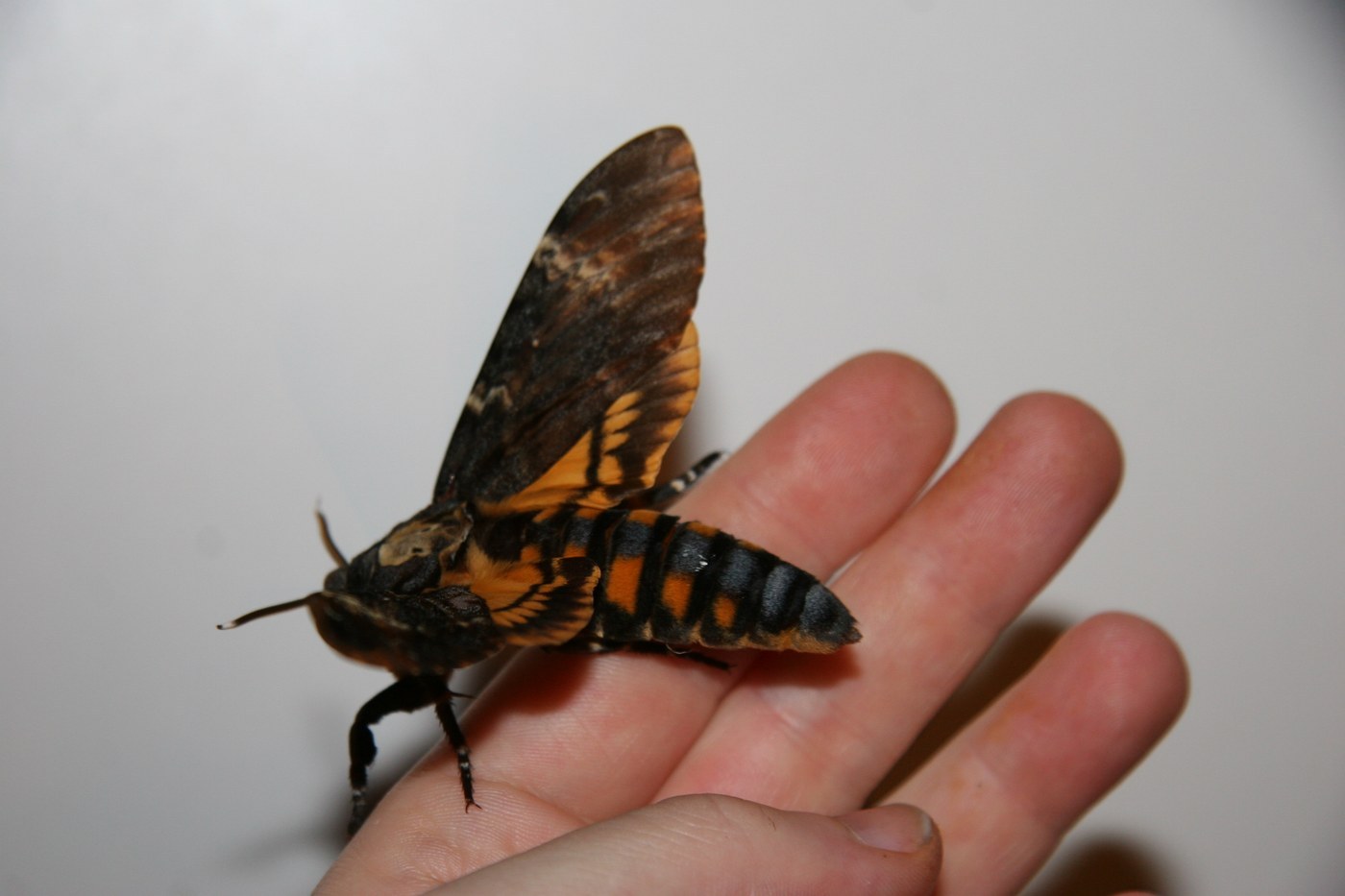
Key Visual Features
The death's-head hawkmoth (Acherontia atropos) is one of the largest moths found in Europe and Africa, with a wingspan of roughly 3.5 to 5 inches and a thick, robust, furry body. Its most famous field mark is the pale, skull-and-crossbones-like pattern on the top of the thorax, formed by cream and brown markings that resemble a human skull outline. The forewings are mottled in wavy patterns of brown, black, and tan, providing excellent camouflage against bark. The hindwings are bright yellow crossed with dark bands. The tapering abdomen alternates bands of yellow and black, similar in coloring to some bees or wasps. The caterpillar stage is large and colorful too, typically green, yellow, or brown with diagonal side stripes and a curved, roughened horn near the rear.
Where and When You'll See It
This species is native to Africa and southern Europe but migrates northward into central and northern Europe during warm months, sometimes turning up far outside its usual range. Adults favor gardens, fields, and areas with nightshade-family plants (such as potato or tobacco crops), which serve as caterpillar host plants. They are strictly nocturnal, resting hidden during the day and becoming active after dark, when they're strongly attracted to artificial lights. Sightings peak in summer through early autumn, coinciding with their seasonal migration and breeding period.
Similar-Looking Bugs
- Other large hawkmoths (Sphingidae): Many share the thick body and mottled forewing pattern, but none display the pale skull-shaped marking on the thorax, making that feature the clearest distinguishing trait.
- Convolvulus hawkmoth: Similar overall size and shape, but its thorax lacks the skull pattern and its banding is arranged differently.
- Privet hawkmoth: Comparable large size, but with pink-and-black banded hindwings rather than yellow-and-black, and no skull marking.
Quick ID Checklist
- Pale skull-like marking on the top of the thorax
- Mottled brown, black, and tan forewings
- Bright yellow hindwings crossed with dark bands
- Yellow-and-black banded, tapering abdomen
- Nocturnal, attracted to lights, most often seen in summer and early fall
Frequently asked questions
What is the most reliable feature for identifying a death's-head hawkmoth?
The pale skull-and-crossbones-shaped marking on top of the thorax is unique to this species and the clearest way to confirm an identification.
When is this moth most likely to be seen?
It is most often spotted in summer and early autumn, when adults are active at night and migrating through warmer regions.
What does the caterpillar look like?
The caterpillar is large and colorful, typically green, yellow, or brown with diagonal side stripes and a distinctive curved, roughened horn near its rear end.
How is it different from other large hawkmoths?
While many hawkmoths share a similar bulky body and mottled wing pattern, the death's-head hawkmoth is unique in having the pale skull-like marking on its thorax.