
Deathwatch Beetle Identification Guide
Learn to identify the deathwatch beetle by its mottled, hairy shell and the faint tapping sound it makes in old timber.
Read the full Deathwatch Beetle encyclopedia entry →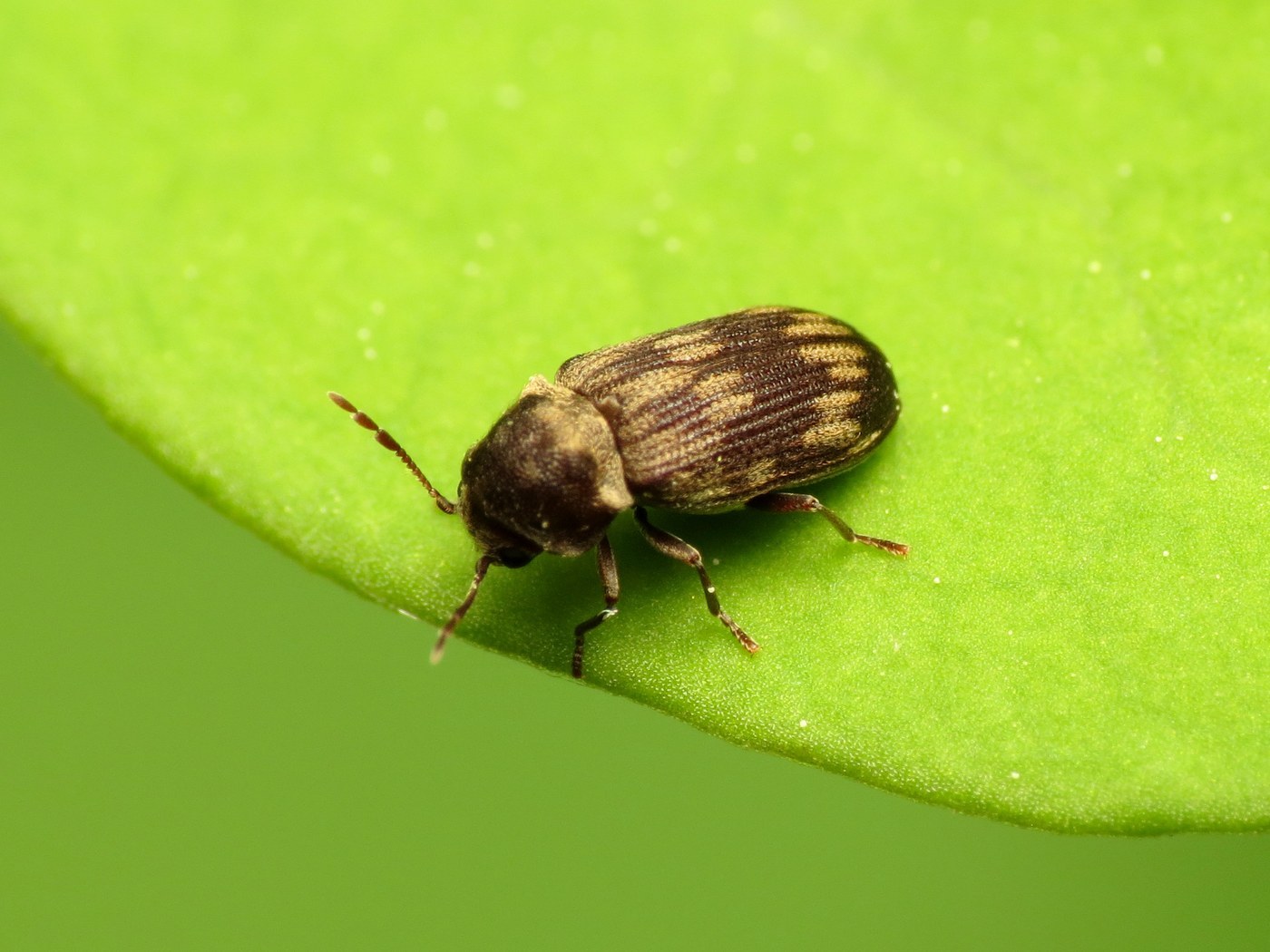
Key Visual Features
The deathwatch beetle (Xestobium rufovillosum) is a small, cylindrical wood-boring beetle, roughly 1/4 to 3/8 inch long, with a mottled reddish-brown to dark brown body covered in patches of short yellowish-gray hair that give it an uneven, blotchy appearance. Unlike some related beetles, its head is hooded and tucked beneath the thorax, making it hard to see from directly above. The thorax has an arched, hump-like shape, and the wing covers show irregular rows of small pits. Adults are most often identified indirectly through the round exit holes (about 1/8 inch) and pellet-shaped frass their larvae leave in old timber, and by a faint, rhythmic tapping sound adults make against wood during the spring mating season as part of their courtship behavior.
Where and When You'll See Them
Deathwatch beetles favor old, partially decayed hardwood and softwood timbers, especially oak, that have been affected by fungal decay, which softens the wood for larval feeding. They're most associated with older buildings, historic structures, church roofs, and aged furniture in Europe, though related species occur elsewhere. Adult emergence and the characteristic tapping behavior peak in spring, typically April through June, when beetles are seeking mates within the wood.
Similar-Looking Bugs
- Furniture beetle — smaller overall, with finer, gritty frass and a less hairy, more uniformly colored body.
- Powderpost beetle — produces very fine, flour-like powder rather than the coarser bun-shaped pellets of the deathwatch beetle, and has a visible (non-hooded) head.
- Old house borer — much larger, with a distinctly different mottled gray pattern and oval exit holes.
Quick ID Checklist
- Mottled reddish-brown body with patches of yellowish hair, 1/4 to 3/8 inch
- Head hooded beneath the thorax, not visible from above
- Round exit holes about 1/8 inch with bun-shaped pellet frass
- Found in old, partially decayed hardwood timber
- Faint tapping sound heard during spring mating season
Frequently asked questions
Why is it called the deathwatch beetle?
The name comes from the faint tapping sound adults make against wood during spring courtship, which was historically noticed in quiet rooms and associated with folklore rather than any actual danger.
How can I identify deathwatch beetle exit holes?
Look for round holes about 1/8 inch across, often accompanied by coarse, bun-shaped pellet frass in aged, partially decayed timber.
What kind of wood does the deathwatch beetle prefer?
It favors old hardwood, especially oak, that has already been softened by fungal decay, which is why it's often found in historic structures.
When is the deathwatch beetle's tapping sound most noticeable?
The tapping behavior is most common in spring, roughly April through June, during the beetle's mating season.