
Desert Locust Identification Guide
Recognize this notorious swarming grasshopper by its color-changing phases and long flight-ready wings.
Read the full Desert Locust encyclopedia entry →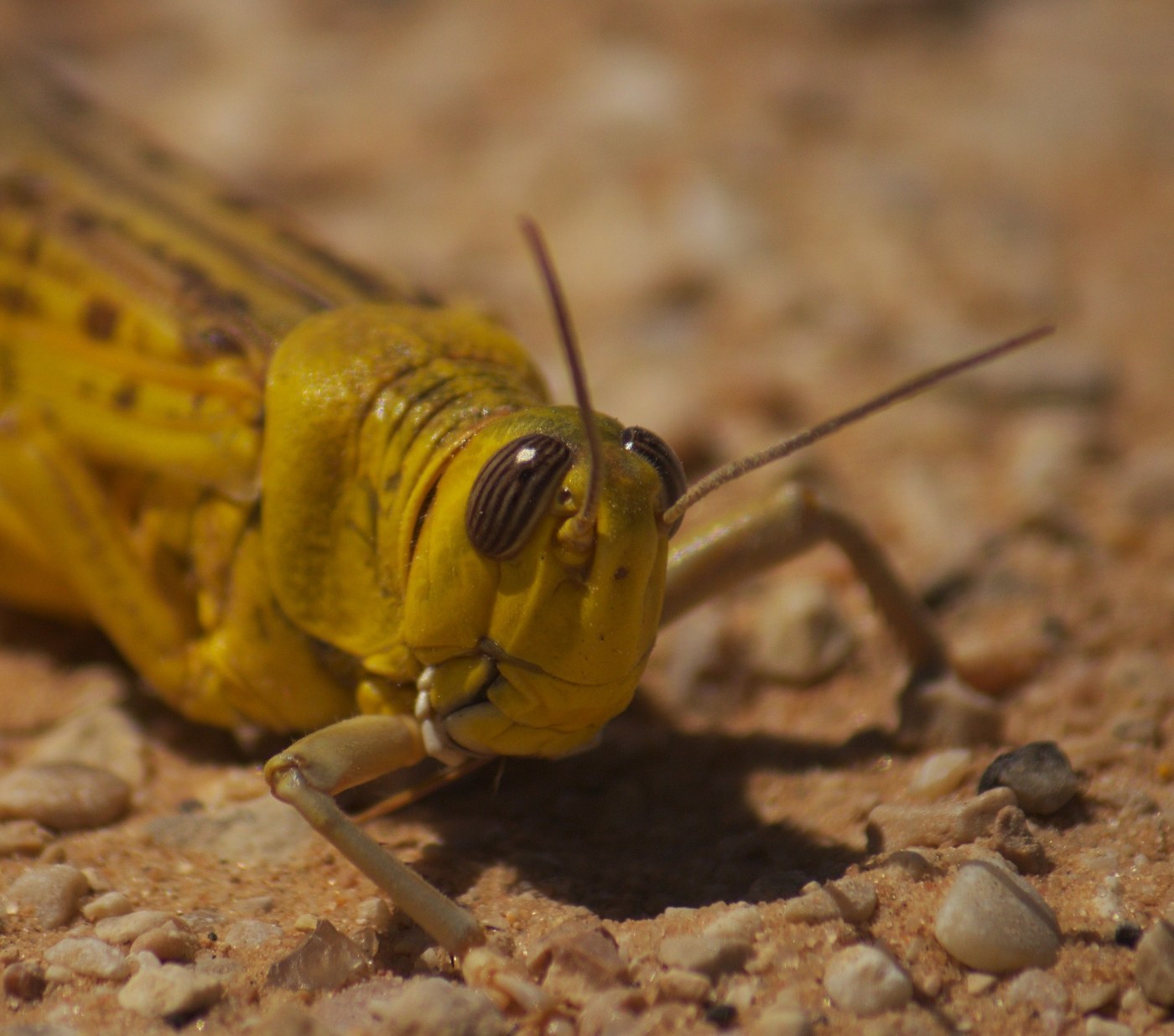
Key Visual Features
The desert locust (Schistocerca gregaria) is a large grasshopper species, typically 1.8 to 3 inches long, with females larger than males.
- Body shape: Robust, elongated body with a rounded head, large compound eyes, and short antennae relative to body length.
- Legs: Strong, enlarged hind legs built for powerful jumping, along with slender front and middle legs.
- Wings: Long, narrow forewings and broader hindwings that extend well past the tip of the abdomen, giving it strong, sustained flight capability.
- Color and phases: This species shows dramatic color change depending on population density. Solitary individuals are typically dull green, brown, or gray, camouflaging against dry vegetation and sand. When crowded into swarms, nymphs turn bright pink-orange with black markings, and swarming adults become yellow with darker mottling.
Where and When You'll See It
Desert locusts inhabit arid and semi-arid regions across northern and eastern Africa, the Arabian Peninsula, and parts of southwestern Asia. Solitary individuals live scattered across sparse desert vegetation and are hard to notice. After periods of rainfall that trigger vegetation growth, populations can multiply and shift into the gregarious swarming phase, forming dense groups that migrate in search of food, most active during daylight hours.
Similar-Looking Species
- Migratory locust: Occurs across a broader Old World range and typically shows more contrasting black chevron-like markings on a brownish or yellow-brown body in the swarming phase; the desert locust's swarming adults are more uniformly yellow.
- Other Schistocerca grasshoppers (such as the American grasshopper): Generally do not form the same large-scale swarming aggregations or exhibit the same dramatic phase-based color shift.
- Common field grasshoppers: Usually smaller, do not change color with crowding, and lack the extreme long-distance flight and swarming behavior.
Quick ID Checklist
- Large body (roughly 2-3 inches) with long flight-capable wings
- Solitary phase: dull brown/green/gray for camouflage
- Gregarious phase: pink-orange nymphs, yellow-mottled swarming adults
- Strong hind legs for jumping, found in arid and semi-arid regions
- Appears in dense migrating swarms after rains in Africa, the Middle East, and southwestern Asia
Frequently asked questions
Why does the desert locust change color?
Its coloring shifts depending on population density: scattered solitary individuals are camouflage-colored brown or green, while crowded, swarming populations turn pink (as nymphs) or yellow (as adults).
How big is a desert locust?
Adults typically range from about 1.8 to 3 inches long, with females generally larger than males.
How do you tell a desert locust apart from a regular grasshopper?
Desert locusts are a type of grasshopper capable of shifting between a solitary form and a dense-swarming form with distinct coloring, a behavior most common grasshoppers do not display.
Where are desert locusts typically found?
They live in arid and semi-arid regions of Africa, the Arabian Peninsula, and southwestern Asia, forming large migrating swarms after favorable rains.