Diamondback Moth Identification Guide
Learn to spot this tiny, slender moth by the pale diamond-shaped pattern that forms along its back when its wings are folded.
Read the full Diamondback Moth encyclopedia entry →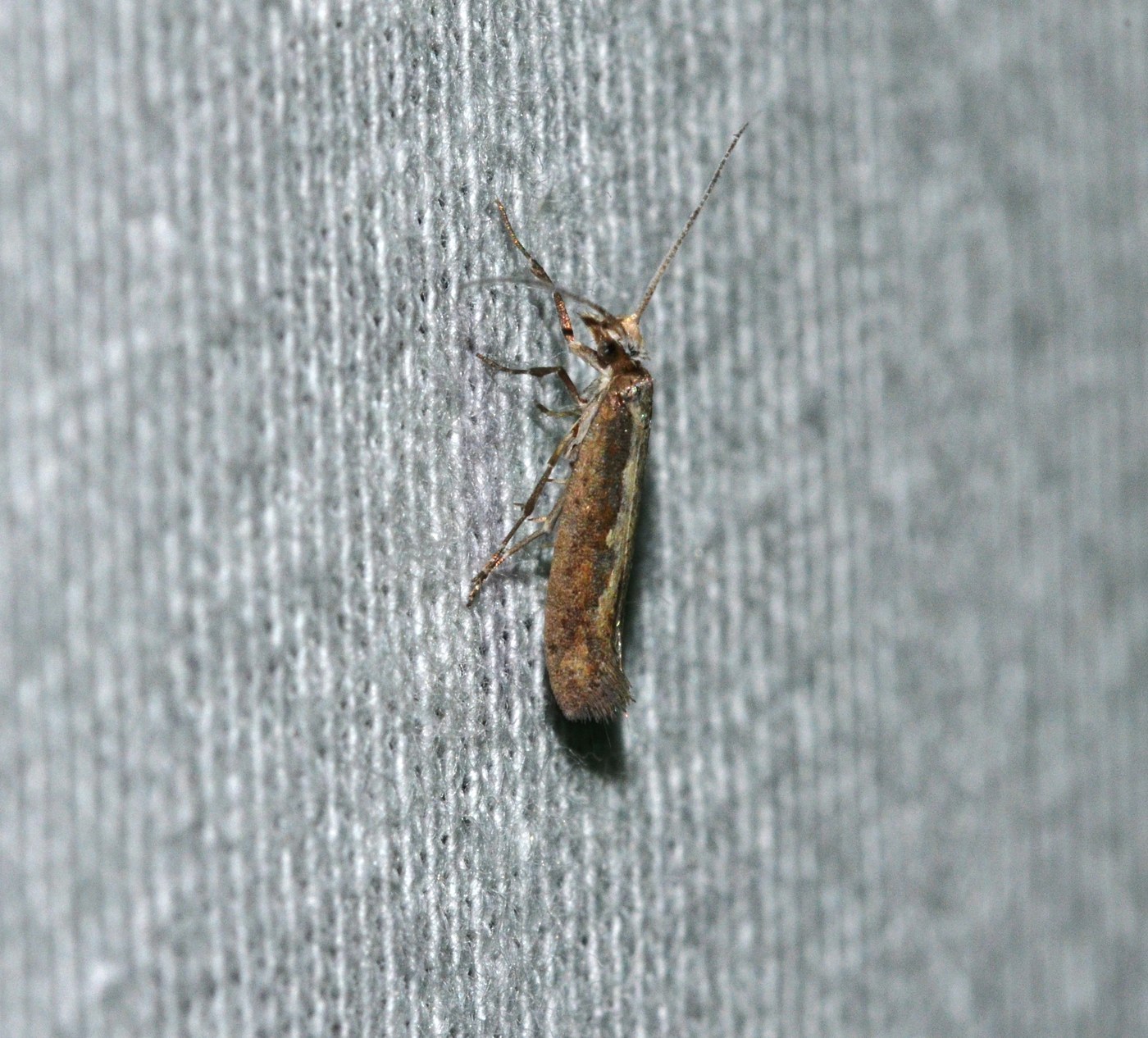
Key Visual Features
The Diamondback Moth (Plutella xylostella) is a very small, slender moth with a wingspan of only about 0.5 to 0.7 inches (13 to 17 mm), so close observation is often needed. Identifying features include:
- Narrow, elongated grayish-brown to tan forewings with mottled darker brown markings
- A pale cream, tan, or whitish wavy stripe running along the inner edge of each folded forewing; when the wings are closed at rest, these stripes from both wings line up to form a distinctive pale diamond (rhombus) shape down the center of the back
- Fringed wing edges with fine hair-like scales, especially noticeable on the narrow hindwings
- A slim, delicate body with long, thread-like antennae often held forward or swept back
- Long legs that give the moth a somewhat leggy, delicate look at rest
At rest, this moth often adopts a distinctive head-up, slightly raised posture with the body angled upward and wings held rooflike over the back, which along with the diamond pattern is one of the best field clues.
Where and When You'll See It
The Diamondback Moth is found nearly worldwide, in open fields, gardens, and areas where brassica-family plants (such as cabbage, mustard, and related wild plants) grow, as these are the caterpillars' host plants. Adults are small, fast, and mostly active at dusk and at night, though they can sometimes be flushed from vegetation during the day. In warmer climates the species breeds continuously with multiple overlapping generations throughout the year, while in temperate regions it is most abundant from spring through autumn.
Similar-Looking Moths
- Other small "diamondback"-type moths in the family Plutellidae: Share the slender build and pale dorsal stripe, but exact pattern and coloring can vary; close inspection of the diamond outline shape and wing fringe is needed to confirm.
- Small tortrix or leafroller moths: Can appear similarly sized and mottled but generally lack the clean pale diamond outline down the back and have a broader, more triangular wing shape at rest.
- Grass moths (Crambidae): Often confused due to small size and slender shape, but these typically hold their wings tightly wrapped around the body in a narrow tube shape rather than the Diamondback Moth's rooflike stance.
Quick ID Checklist
- Very small, slender moth, wingspan under an inch
- Pale cream or tan diamond-shaped pattern visible down the folded back
- Mottled grayish-brown forewings with fringed edges
- Long thread-like antennae and legs, giving a delicate look
- Found near brassica-family plants such as cabbage or mustard, active at dusk/night
Frequently asked questions
How did the Diamondback Moth get its name?
When its wings are folded at rest, pale stripes along each forewing's inner edge line up to create a distinctive diamond, or rhombus, shaped pattern running down the middle of its back.
Why is this moth so hard to spot?
It is very small, with a wingspan under an inch, and its mottled grayish-tan coloring blends well with foliage, so it often goes unnoticed unless closely examined at rest.
What plants are most likely to have Diamondback Moths nearby?
Look near brassica-family plants such as cabbage, mustard, and related wild relatives, since these serve as the primary host plants for the caterpillars.
Is the Diamondback Moth found worldwide?
Yes, it is one of the most widely distributed moth species globally, found on nearly every continent where suitable host plants and climate conditions occur.
Diamondback Moth identified by the community
Recent Diamondback Moth finds identified with Bug Identifier.