
Diana Fritillary Identification Guide
A large, dramatically dimorphic fritillary of southern forests, with fiery orange males and iridescent blue-black females.
Read the full Diana Fritillary encyclopedia entry →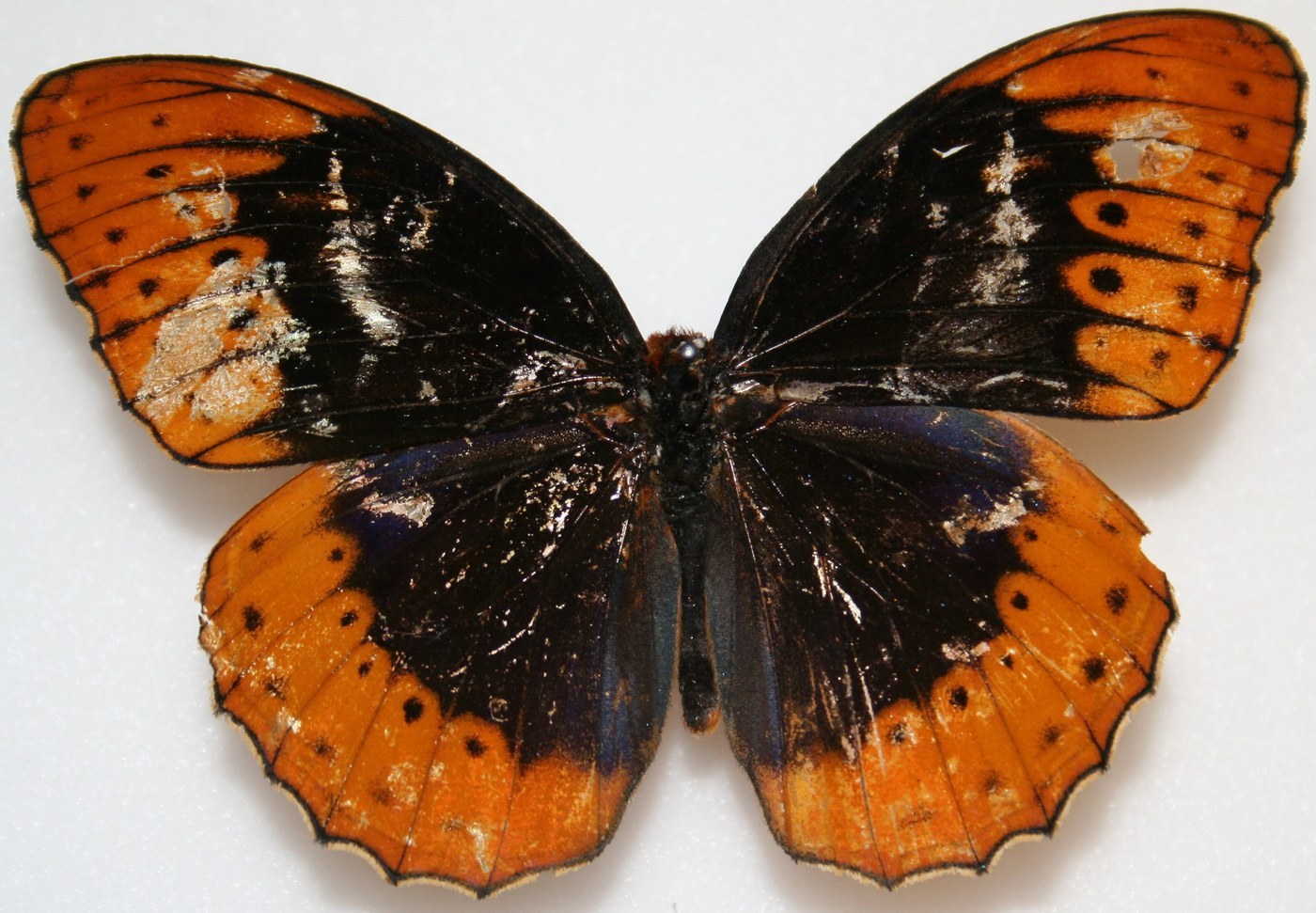
Key Visual Features
The Diana Fritillary (Argynnis diana, also Speyeria diana) is one of the largest and most sexually dimorphic fritillaries in North America, with a wingspan of about 3.1 to 4.7 inches.
- Males have bright orange outer wing portions with dark brown-black bases and bold black markings; they resemble a typical large fritillary at first glance
- Females are dramatically different: their wings are iridescent blue-black overall, marked with pale blue to blue-white spots and bands, an appearance thought to mimic the unpalatable Pipevine Swallowtail
- Underside hindwing in both sexes is brownish with pale markings, but it lacks the heavy silver spotting seen in many other Speyeria fritillaries
- Wings are broad and rounded, and the body is large and robust for the genus
- Flight is strong and can appear almost swallowtail-like in females, especially in low light
Where and When to Look
Diana Fritillaries live in the moist wooded ravines, forest edges, and rich hollows of the Appalachian Mountains and the Ozark-Ouachita highlands of the south-central and southeastern United States. They favor shaded streamside habitats within otherwise forested landscapes. There is a single generation per year; males typically emerge in June, patrol territories through midsummer, and become scarce by late summer, while females, which emerge slightly later, can be seen into September nectaring on flowers such as ironweed and thistle in sunny openings near forest.
Similar-Looking Species
- Regal Fritillary: females of that species also show dark hindwings, but Regal forewings stay orange in both sexes, whereas Diana females turn the entire wing blue-black; ranges also differ, with Regal tied to prairies rather than forested mountains
- Pipevine Swallowtail: female Diana Fritillaries are often mistaken for this swallowtail due to similar iridescent blue coloring, but the Diana lacks tails on the hindwings and has a rounder wing shape
- Great Spangled Fritillary: both sexes remain orange-brown with heavy silver spotting below, unlike Diana's blue-black females and unspotted underside
Quick ID Checklist
- Very large fritillary, wingspan up to nearly 5 inches
- Males: orange outer wings with dark bases; Females: iridescent blue-black overall
- No tails on the hindwing (unlike swallowtails females may resemble)
- Underside lacks heavy silver spotting
- Restricted to moist forested ravines in Appalachian and Ozark regions
Frequently asked questions
Why do male and female Diana Fritillaries look so different?
The species shows strong sexual dimorphism: males stay orange like typical fritillaries, while females have evolved iridescent blue-black wings that closely resemble the unrelated Pipevine Swallowtail.
Could I confuse a female Diana Fritillary with a swallowtail?
It is a common mix-up because of the similar blue-black coloring, but the Diana Fritillary lacks the tail extensions on the hindwings that swallowtails have.
Where is this species typically found?
It is restricted to moist, forested habitats in the Appalachian Mountains and the Ozark-Ouachita highlands, usually near streams or shaded ravines.
When during the year can I see Diana Fritillaries?
There is one generation per year; males are most visible in June and July, while females can be seen into September.