
Drinker Moth Identification Guide
A large, softly furred orange-yellow moth with wavy wing lines, commonly found resting among tall grasses near water.
Read the full Drinker Moth encyclopedia entry →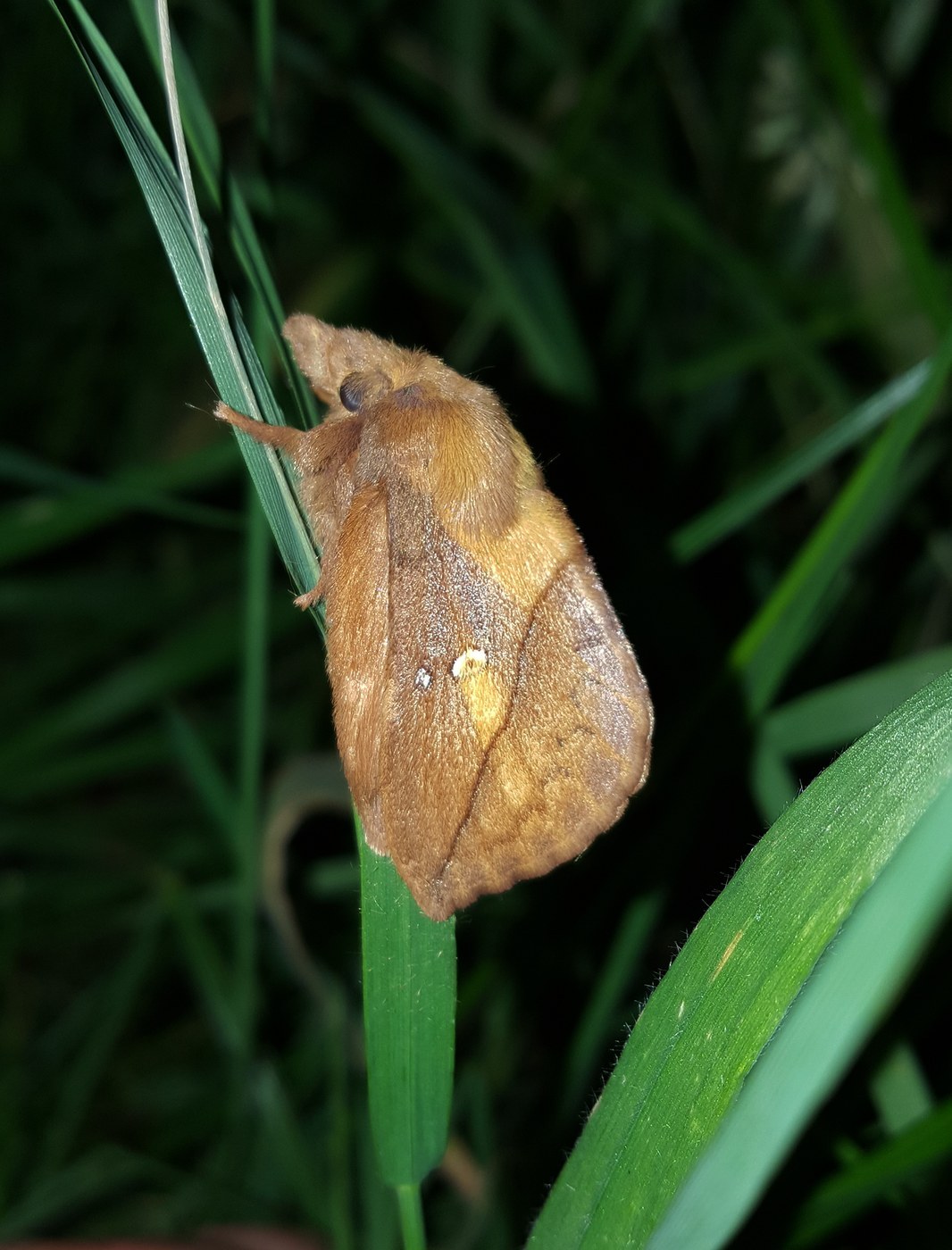
Key Visual Features
The Drinker Moth is a large, robust member of the eggar moth family, with a wingspan of about 45-70mm.
- Males: Smaller and brighter, with rich orange-brown wings.
- Females: Larger, paler straw-yellow to buff colored, sometimes noticeably bigger-bodied than males.
- Forewing pattern: Crossed by two darker, wavy diagonal lines that converge toward the wing tip, plus one or two small white spots near the center.
- Body: Stout and densely furry, typical of the eggar family; antennae are feathery (comb-like) in males and simpler in females.
- Resting posture: Wings held tent-like, covering the body, with the moth often clinging to a grass stem in a head-down or angled position.
Where and When You'll See It
Look for Drinker Moths in damp, grassy habitats - riversides, reedbeds, marsh edges, and rough, unmown meadows. The species gets its common name from the caterpillar's habit of drinking dew or raindrops from grass blades. Adults fly at night during a single generation from June through August and are frequently attracted to outdoor lighting; by day, they rest low among grass stems where their coloring blends in well.
Similar-Looking Species
- Fox Moth - has distinct pale cross-bands rather than wavy diagonal lines, is generally more reddish, and flies earlier in the year (spring, partly by day).
- Oak Eggar - more compact wing shape with a single pale band and a pale disc spot, typically found in drier habitats like heathland and hedgerows.
- Grass Eggar - similar overall shape and coloring but usually found in drier coastal or scrubby habitats, with subtly different wing markings.
Life Cycle & Behavior
Eggs are laid in batches on grass stems, and the resulting caterpillars feed through late summer and autumn before overwintering while still small, sheltering low in grass tussocks. They resume feeding in spring, growing into large, hairy larvae before spinning a boat-shaped cocoon low in vegetation. Adults emerge for a single generation each summer and are short-lived, non-feeding fliers.
Quick ID Checklist
- Large, furry moth with a wingspan up to 7cm
- Forewings orange-brown (male) or pale straw-yellow (female) with two wavy diagonal lines
- One or two small white spots on the forewing
- Found resting low in damp grassy vegetation near water
- Nocturnal, flying June through August
Frequently asked questions
Why is it called the Drinker Moth?
The name comes from the caterpillar's habit of drinking dew and raindrops collected on grass blades in its damp grassland habitat.
How do I tell a male from a female Drinker Moth?
Males are smaller and more vividly orange-brown, while females are noticeably larger and paler, with a straw-yellow to buff coloring.
What habitat is best for finding this species?
Damp, grassy places such as riverbanks, reedbeds, and unmown wet meadows are the most reliable places to encounter Drinker Moths.
What's the best way to distinguish it from the Fox Moth?
The Drinker Moth has wavy diagonal lines across the forewing rather than distinct pale bands, is generally more yellow-orange, and flies later in summer rather than spring.