Dung Beetle Identification Guide
Recognize these compact, armored beetles by their rounded bodies, digging legs, and habit of rolling or burying dung.
Read the full Dung Beetle encyclopedia entry →Key Visual Features
Dung beetles are a diverse group of scarab beetles united by their rounded, armored build and specialized digging or rolling behavior.
- Size: Highly variable by species, from about 0.2 inches up to 2.5 inches in the largest species.
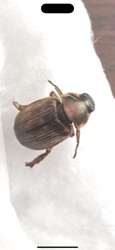
- Color: Ranges from matte black and dark brown to species with metallic green, blue, or bronze sheens.
- Body shape: Compact, rounded to oval, convex body with a hard, domed exterior typical of scarab beetles; body appears heavily armored and smooth.
- Wings: Hardened elytra cover the abdomen completely at rest, protecting membranous flight wings used for locating fresh dung.
- Legs: Front legs are often broadened, flattened, and toothed for digging and shoveling; some rolling species have long, slender hind legs used to maneuver dung balls.
- Antennae: Short, clubbed antennae ending in a small fan of plates (lamellae) that can open to detect odors.
- Horns: Many species, especially males, bear a single horn or small projection on the head or thorax used in competition with other males.
Where and When You'd See One
Dung beetles are found worldwide wherever grazing animals occur — pastures, grasslands, savannas, and woodland edges. They're most active in warm months, from spring through fall in temperate climates, and can be seen flying to fresh dung within minutes of it being deposited, or found already at work digging beneath or rolling a ball away from a pile. Some species are most active by day, others at dusk or night, depending on the species and region.
Similar-Looking Bugs
- Scarab beetles in general (June beetles, chafers): Share the rounded scarab shape but lack the digging-adapted front legs and dung-focused behavior of true dung beetles.
- Carrion beetles: Similarly attracted to decaying material but typically flatter-bodied with more visible, clubbed antennae and different behavior (feeding on carcasses rather than dung).
- Ground beetles: Longer-legged, more elongated, and flattened rather than domed and rounded; ground beetles are predators, not dung feeders.
- Rhinoceros beetles: Much larger with a prominent single or forked horn, generally not associated with dung.
Quick ID Checklist
- Compact, rounded, heavily armored scarab-shaped body
- Broadened, toothed front legs built for digging
- Short antennae ending in a fan-shaped club
- Found on or near fresh dung, digging, rolling, or tunneling
- Some species show a head or thorax horn, especially males
Frequently asked questions
How can I tell a dung beetle from other rounded scarab beetles?
Look for broad, flattened, tooth-edged front legs built for digging and shoveling, and check whether the beetle is actively associated with dung — digging beneath it, tunneling, or rolling a ball away.
Do all dung beetles roll balls of dung?
No, only some species are 'rollers' that shape and push dung balls; many others are 'tunnelers' that bury dung directly beneath the pile, or 'dwellers' that live inside it, without rolling anything.
What color are dung beetles usually?
Most are matte black or dark brown, though a number of species have a metallic green, blue, or bronze sheen to their hardened wing covers.
Why do some dung beetles have a horn?
In many species, males develop a horn on the head or thorax that is used in physical contests with rival males; horn size can vary noticeably between individuals of the same species.
Dung Beetle identified by the community
Recent Dung Beetle finds identified with Bug Identifier.