European Stag Beetle Identification Guide
Spot this iconic woodland beetle by the male's huge antler-like jaws and its heavy, near-vertical flight.
Read the full European Stag Beetle encyclopedia entry →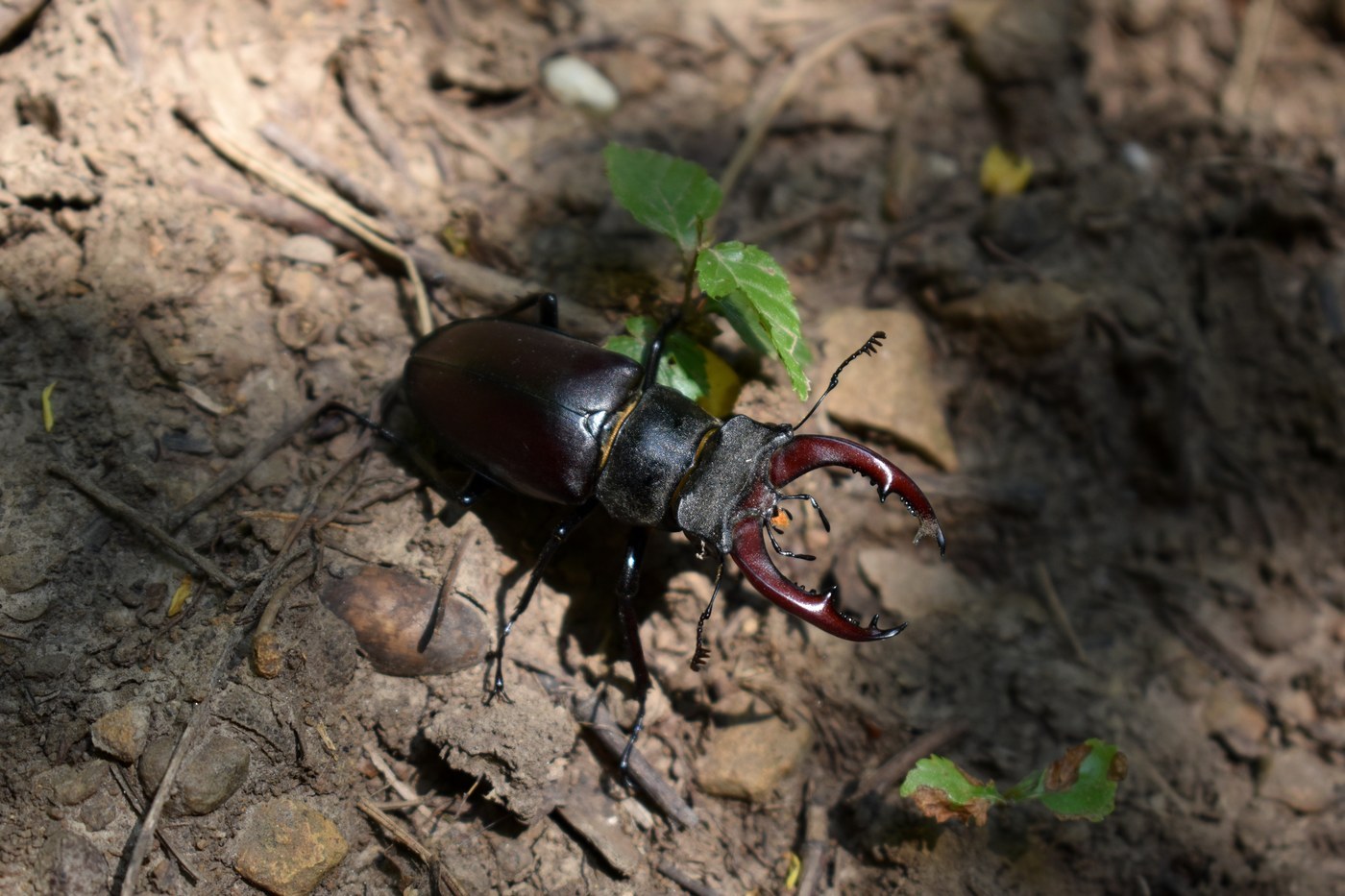
Key Visual Features
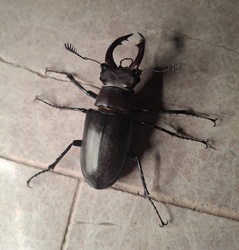
The European stag beetle is one of Europe's largest and most recognizable beetles, named for the male's oversized jaws:
- Size: Males range from about 1 to 3 inches (25-75mm) long, including their mandibles; females are smaller, generally under 1.6 inches (40mm).
- Mandibles (males): Large, branched, reddish-brown mandibles resembling deer antlers, used to wrestle rival males; these can make up a significant portion of the beetle's total length.
- Coloring: A glossy black to dark reddish-brown body; males often show a somewhat lighter reddish-brown tone on the mandibles and head compared to their darker body.
- Females: Much smaller mandibles that look more like simple pincers than antlers, and an overall shinier, uniformly black body.
- Body shape: Elongated and robust, with a distinct head, thorax, and hardened elytra.
Where and When You'll See One
European stag beetles are found across much of Europe, particularly in old woodlands, parks, and gardens with decaying wood or old tree stumps nearby, which their larvae depend on. Adults emerge in late spring and are most active at dusk and in the early evening during summer, when males can be seen flying between trees, often with their body angled steeply upward due to the weight of their mandibles.
Similar-Looking Bugs
- Lesser stag beetle: Smaller overall, with a more uniformly black body and shorter, less branched mandibles that lack the antler-like shape of the European stag beetle.
- Rhinoceros beetle: Also large and dark-bodied, but has a horn projecting from the head or thorax rather than enlarged mandibles at the front of the head.
- Ground beetles (large Carabus species): Similar dark, glossy coloring but a flatter body and normal-sized jaws, without the stag beetle's oversized branched mandibles.
Behavior Notes
Because of the weight of their oversized mandibles, flying males often tilt their body at a steep upward angle to keep balanced in the air, a flight posture that is itself a helpful field clue. Adults spend much of the daytime resting in cover near decaying wood and become active as temperatures drop in the evening.
Quick ID Checklist
- Males have large, branched, antler-like reddish-brown mandibles
- Females have much smaller, simple pincer-like mandibles
- Glossy black to dark reddish-brown body
- Found near old woodland, decaying stumps, or logs
- Active at dusk in summer, flying with body held steeply upward
Frequently asked questions
Why do male European stag beetles have such large jaws?
The oversized, antler-like mandibles are used by males to grapple with rival males during competitions, similar to how deer use antlers, rather than for any other purpose.
How can I tell a male from a female European stag beetle?
Males have large, branched, antler-like mandibles, while females have much smaller, simple pincer-shaped mandibles and a generally smaller, shinier black body.
When is the best time of day to see a European stag beetle?
They are most active at dusk and in the early evening during the summer months, when males can often be seen flying between trees.
Where do European stag beetles typically live?
They favor old woodlands, parks, and gardens that have decaying wood, stumps, or old tree roots nearby, since their larvae depend on this decaying wood habitat.
European Stag Beetle identified by the community
Recent European Stag Beetle finds identified with Bug Identifier.