
Eyed Hawk-Moth Identification Guide
Identify this camouflaged hawk-moth by the pair of startling blue-black eyespots it flashes on its hindwings when disturbed.
Read the full Eyed Hawk-Moth encyclopedia entry →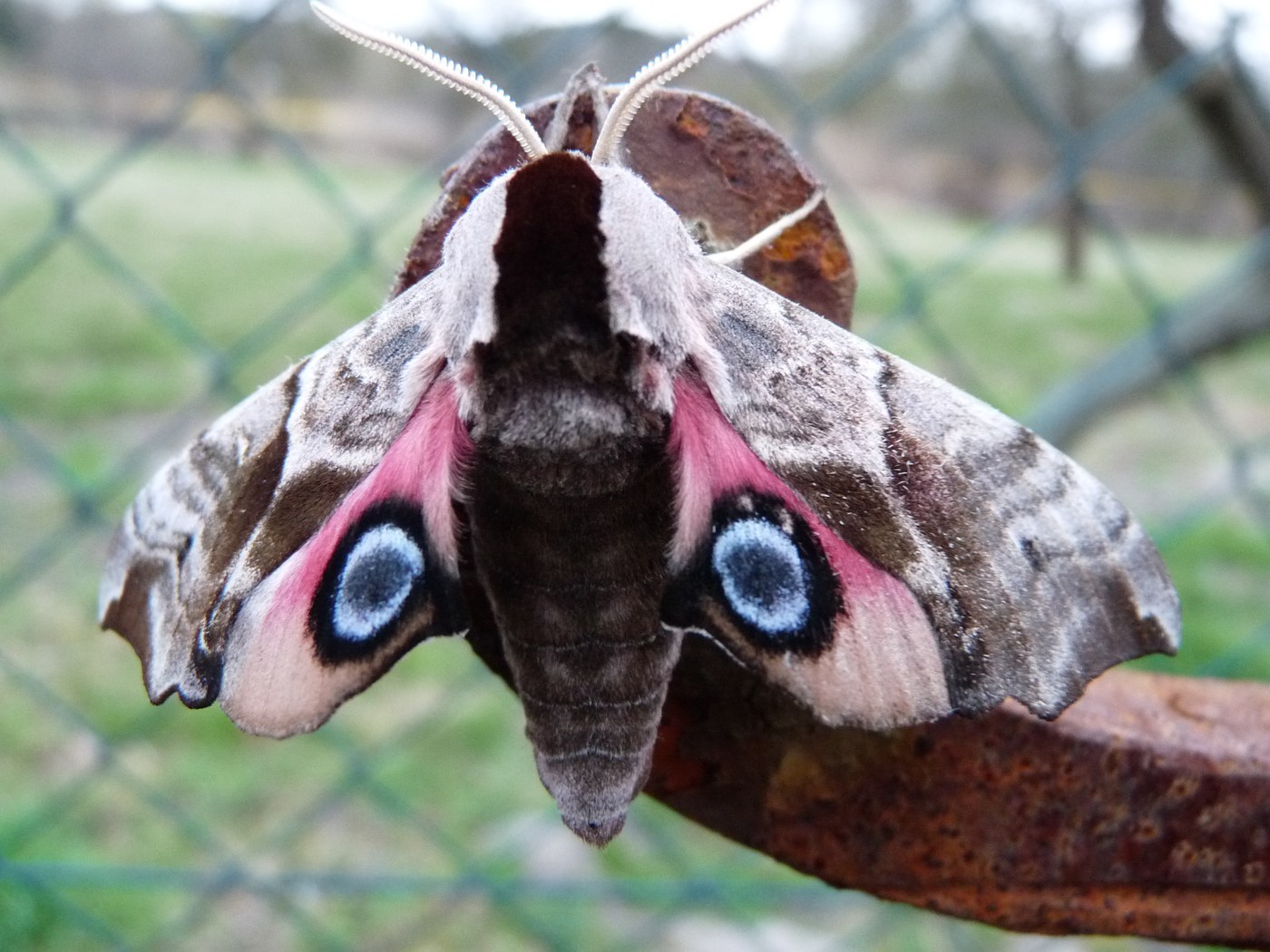
Key Visual Features
The Eyed Hawk-Moth (Smerinthus ocellata) is a medium-large European hawk-moth with a wingspan of roughly 2.8 to 3.3 inches (7 to 8.5 cm). Its most striking feature is normally hidden, making careful observation important:
- Forewings in muted gray-brown to pinkish-brown tones with subtle darker mottling, providing excellent camouflage against bark
- Wavy or slightly scalloped forewing edges
- Hindwings that are mostly rosy-pink to salmon colored, each bearing a large, bold "eyespot" made of a blue-black center ringed with white and black — normally concealed beneath the forewings
- A stocky, tapering body in grayish-brown tones matching the forewings
- Short, stout antennae typical of hawk-moths
At rest, the Eyed Hawk-Moth conceals its hindwing eyespots completely, appearing as a plain grayish-brown moth. When disturbed, it can suddenly lower or shift its forewings to reveal the pair of large blue-black "eyes," an unmistakable identifying display.
Where and When You'll See It
This species is found across much of Europe and into temperate Asia, in gardens, orchards, hedgerows, riverbanks, and woodland edges wherever willow, apple, or poplar trees grow, as these are the primary caterpillar host plants. Adults fly at night in a single generation from late spring into summer, typically May through July depending on region. They are attracted to outdoor lighting and can also be found resting motionless during the day on tree trunks, fences, or foliage, relying on camouflage until disturbed. Because the eyespots stay hidden unless the moth is provoked, patient, careful observation of a stationary individual is often needed to see the full pattern.
Similar-Looking Moths
- Poplar Hawk-Moth: Similar grayish-brown coloring and habitat, but shows only plain reddish patches on the hindwing rather than bold blue-black eyespots.
- Lime Hawk-Moth: More olive-green to pinkish-tan with distinctly scalloped wing edges and no hidden eyespots.
- Privet Hawk-Moth: Much larger with a bold pink-and-black striped abdomen, lacking hindwing eyespots entirely.
- Butterflies with eyespots: Some day-flying butterflies also show large eyespots, but the Eyed Hawk-Moth's streamlined sphinx-moth body shape and strictly nocturnal habits set it apart.
Quick ID Checklist
- Grayish-brown forewings providing bark-like camouflage
- Hidden blue-black eyespots on rosy-pink hindwings, revealed only when disturbed
- Wingspan around 2.8–3.3 inches
- Wavy, slightly scalloped forewing margins
- Found resting on bark near willow, apple, or poplar in late spring to summer
Frequently asked questions
Why is it called the Eyed Hawk-Moth?
The name comes from the pair of large, eye-like markings on its hindwings — a blue-black center ringed in white and black — which are normally hidden but can be revealed suddenly when the moth is disturbed.
How do I see the eyespots if they are usually hidden?
The eyespots are tucked beneath the forewings at rest and only become visible if the moth shifts its forewing position, which it may do briefly when disturbed or handled gently.
How can I tell an Eyed Hawk-Moth from a Poplar Hawk-Moth?
Both share grayish-brown forewing coloring, but the Poplar Hawk-Moth shows only plain reddish hindwing patches, while the Eyed Hawk-Moth has bold blue-black eyespots on its hindwings.
What trees are best to check when looking for this species?
Look near willow, apple, or poplar trees, since these serve as the main host plants for the caterpillars and adults are often found resting nearby.