Fire Ant Queen Identification Guide
Learn to recognize the larger, darker reproductive ant responsible for founding and heading a fire ant colony.
Read the full Fire Ant Queen encyclopedia entry →Key Visual Features
A fire ant queen is easy to distinguish from the small workers most people associate with the species, mainly through her much larger size.
- Size: Considerably larger than workers, typically 8–10 mm (about 0.3–0.4 inches) long, roughly double the size of a large worker.
- Color: Dark reddish-brown to nearly black, generally darker overall than the reddish-orange workers.
- Body shape: A noticeably enlarged, elongated abdomen (gaster) compared to workers, needed to house developed reproductive organs for continuous egg-laying.
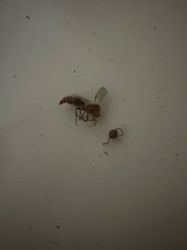
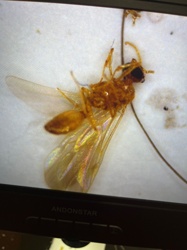
- Wings: Newly matured queens (alates) have two pairs of wings before their mating flight; once a colony is founded, the queen breaks off her wings and remains permanently wingless, often with small wing stubs visible.
- Legs: Six legs, proportionate to the body, similar in structure to workers but on a larger frame.
- Antennae: Elbowed, with a distinct club at the tip, matching the antennal structure of workers but on a larger scale.
Where and When You'll See One
Queens are far less commonly observed than workers because they spend most of their life inside the nest.
- Winged queens are typically seen during nuptial flights, often after warm, humid weather following rain, when large numbers of winged reproductives emerge from mounds simultaneously.
- After mating, a queen sheds her wings and either digs a small founding chamber alone or is escorted into an existing nest.
- Established queens live deep within the mound and are rarely seen unless a mound is disturbed or excavated.
- Mounds themselves — loose, dome-shaped dirt piles without a single obvious entrance hole — are the most common visible sign of an active colony.
Similar-Looking Bugs
- Fire ant workers: Much smaller and more uniformly reddish-orange, without the enlarged abdomen of a queen.
- Winged male fire ants: Similar in having wings during the nuptial flight but noticeably smaller and slimmer than winged queens, with a smaller head and abdomen.
- Carpenter ant queens: Generally larger still and solid black or bicolored, with a different mound or nesting structure (wood-associated rather than soil mounds).
- Termite alates: Often mistaken for flying ant queens during swarms, but termites have a straight-waisted body (no narrow constriction), straight antennae, and equal-length wings.
Quick ID Checklist
- Noticeably larger than typical workers, with an enlarged abdomen
- Dark reddish-brown to blackish coloring, darker than workers
- Winged only briefly during the mating flight; wingless (sometimes with wing stubs) afterward
- Elbowed, clubbed antennae matching worker structure but on a larger scale
- Found deep within a dome-shaped soil mound rather than out foraging
Frequently asked questions
How can I tell a fire ant queen from a worker?
The queen is much larger, roughly double the size of a big worker, with a distinctly enlarged abdomen and darker overall coloring.
Why do I sometimes see swarms of winged ants after rain?
Warm, humid conditions following rain often trigger a nuptial flight, when winged queens and males emerge from mounds together to mate in the air.
Does the queen keep her wings after mating?
No, a mated queen breaks or sheds her wings shortly after the mating flight and remains wingless for the rest of her life, sometimes leaving small visible wing stubs.
How do I tell a fire ant queen from a termite alate during a swarm?
Fire ant queens have an elbowed antenna and a distinctly narrow waist between body segments, while termite alates have straight antennae and a broader, unconstricted waist.
Fire Ant Queen identified by the community
Recent Fire Ant Queen finds identified with Bug Identifier.